(My column in Mint Lounge, May 06 2017)

image1.jpg

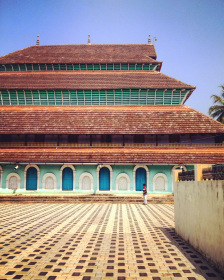
When Nakhuda Mithqal, a Yemeni merchant trading with China and Persia, built what is today called the Mishkal Mosque in Kozhikode, little did he envision the significance this structure would assume over 600 years later as a testament to India’s pluralism. For while the going fallacy presents the subcontinent’s inaugural encounter with Islam as a resounding clash featuring blood and war, Mishkal is a reminder that the Prophet’s religion arrived in our land through peaceful embassies of commerce. Indeed, not only was Islam welcomed and embraced in the south, but the first mosque was consecrated on Indian shores in 629 AD, during the very lifetime of Muhammad, nearly a century before invaders forced their way into Sindh and opened a different kind of history in the north.

That ancient mosque still stands in Kodungallur, but it was in Kozhikode that Nakhuda chose to build his monument. By the 13th century, this Kerala port had emerged as one of the world’s great trading cities, and its Hindu rulers—the Zamorins—persuaded every fisherman to raise one son as a Muslim to sail in the eastern seas—Hindus lost caste if they ventured too far into the ocean. The Zamorin’s allies included the sultan of Egypt, the Ottoman Turks and the Deccani Shahs, whom he implored in the 16th century to declare jihad against the Portuguese reign of terror in international waters. Nakhuda was a celebrated merchant in the Zamorin’s capital and the Moroccan Ibn Battuta wrote of his tremendous wealth in his famous travelogue in the 1300s. Mishkal, and a Jami mosque, remain even today two of the city’s most important places of worship.

Kozhikode was reputed for absorbing all kinds of people and cultures. As late as the 17th century, “merchants from all parts of the world, and of all nations”, lived there by “reason of the liberty and security accorded to them” and in “free exercise” of their faiths. While Arabs enjoyed overwhelming influence here, Jews controlled much of the commerce in Kochi, while further south in Kollam, Christians were in charge. And they all built sites of worship that were not only embodiments of devotion, but also ideals of cultural cross-pollination. The old Syrian Christian church in Chengannur, for instance, resembles the Hindu temples of its time, and the rites and rituals of all religions were influenced by those of their counterparts with whom they were in constant conversation.

Mishkal, for instance, is firm in its commitment to Islam—there has been a qazi here since 1343—but so, too, is it firm in its union with the land where it stands. Painted in turquoise blue, the structure has no dome and no minarets but multi-tiered gables and the tiled roof typical of Kerala buildings. Its 47 doors and 24 carved pillars display the workmanship of the same guilds that constructed the Zamorin palaces, and the exquisite motifs on the minbar from where the message of god is preached bears a direct affinity to the carvings adorning Hindu temples. The structure is set on a base of stone and steps run around the building where up to 1,000 faithful have gathered at a time for centuries and bowed to distant Mecca. Kerala, after all, had greater intercourse with Arabia than it did with even parts of India.

It was the Portuguese who introduced conflict into this universe. When Vasco da Gama arrived in Kozhikode in 1498, an Arab exclaimed, “The devil take thee! What brings you here?” It was a quest for Christians and spices that motivated the Portuguese, besides their economic ambition to displace Arabs from control of capital and the seas. The Zamorin refused to expel Muslims from his city as was presumptuously demanded, so the Portuguese disrupted trade. A ship full of Muslim pilgrims was burnt (after it was plundered, of course), and a Brahmin envoy was sent back with a dog’s ears sewed on. The Portuguese had no stake in peace.

Mishkal features significantly in a 1510 confrontation between the Portuguese and Kozhikode. The Zamorin and his forces were engaged elsewhere and the Portuguese arrived with 1,800 men to sack his capital. One commander, it is recorded, “forced his way with impetuous valour through the streets…and reached the royal residence”. But while he proceeded to ransack the palace, leaving not even two bejewelled doors in their frame, a (possibly exaggerated) force of 30,000 men descended upon the city for its defence. The enemy made to retreat, but locals occupied the roofs and “poured upon (them) a continued shower of darts; while (the invaders) entangled in narrow lanes and avenues, could neither advance nor recede”. By the time the white men reached the beach, hundreds were dead, including the over-bold commander.

The Zamorin, on his return, was furious. The Portuguese had set fire to the city and destroyed Mishkal. The ruler didn’t forget the insult. In 1570, generations after this episode, his heirs succeeded in demolishing completely a fort the Portuguese raised in Chaliyam, “leaving,” a contemporary recorded, “not one stone upon another”. All these stones and the wood from Chaliyam were carried into Kozhikode and placed in the yard at Mishkal for the mosque—the structure we see today, over five centuries later, still bears marks from the assault of 1510, but also features walls and doors made from material seized from the Portuguese who assaulted it in the first place.

Today, amid talk about consecrating a Hindu temple upon the ruins of a violently destroyed mosque, perhaps it would be worth reflecting on Mishkal, where a Hindu king reconstructed a Muslim place of worship, and avenged those who were not followers of his faith but were still his people. The Portuguese brought blood and hate into their world, but together this Hindu king and his Muslim subjects chose a greater ideal, preserving in Mishkal both a house of god as well as a timeless principle.

(My column in Mint Lounge, April 29 2017)

williamjones-klre-621x414livemint.jpg

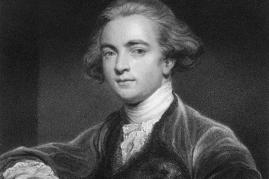
Not many in India today remember William Jones, though at the time of his death in April 1794, he enjoyed what a biographer calls “one of the most phenomenal reputations of all time”. To some he was Persian Jones, the translator of the Tariq-i-Nadiri, while others, after he founded the Asiatic Society in today’s Kolkata, called him, predictably, Asiatic Jones. To one not entirely enraptured crowd, he was Republican Jones, what with his “seditious, treasonable, and diabolical” ideas about popular education and universal (male) suffrage. But as far as India was concerned, it was in his avatar as Oriental Jones that he became one of the sincerest interpreters of our land in the West.

To be sure, Jones was not devoid of imperial prejudice. “I shall certainly not preach democracy to the Indians, who must and will,” he argued, “be governed by absolute power.” As a British judge, he scoffed at any political conception of Indianness; it was India’s historical accomplishments he thought profoundly admirable. “I never was unhappy in England,” he once wrote, “but I never was happy till I settled in India.” Part of it, admittedly, had to do with the splendid £6,000 salary that had attracted him here in the first place—Jones calculated that a decade in India promised stately retirement when finally, unencumbered by financial distress, he could pursue assorted intellectual interests.

Jones was born in 1746 to the daughter of a cabinetmaker and a 71-year-old mathematician, whose peers included Isaac Newton. His father died but the cabinetmaker’s daughter gave him a good education—a worthwhile investment, given his prodigious appetite for learning. By 13, Jones had written his first poem, and by the time of his death knew a grand total of 28 languages. A desire to read the Bible in the original drew him to Hebrew, and an interest in Confucius led him to Chinese. He thought Greek poetry “sublime” but when he “tasted Arabic and Persian poetry”, his enthusiasm for Greek “began to dry up”. The only language he never learnt was his native Welsh.

By his mid-20s, Jones had authored several books and was recognized as an authority on the East. But while accolades and a knighthood arrived, the want of a steady income brought inescapable pressures. “I was surrounded by friends, acquaintances and relatives who encouraged me to expel from my way of life…poetry and Asian literature.” They wanted him to “become a barrister and be devoted to ambition”. He agreed, but managed to orient his legal interests also towards the East, producing the forbiddingly named Mahomedan Law Of Succession To The Property Of Intestates. Naturally, his political ambitions floundered.

It was in 1783, when not yet 37, that he came to India. But, in his typical fashion, he connected his pursuit of money with a pursuit of intellectual stimulation. He drew up a list of 16 subjects, ranging from the Mughal and Maratha political systems to the “Music of the Eastern Nations” and “Medicine, Chemistry, Surgery and Anatomy of the Indians”, to investigate. And it took him only a year-long glance at India’s cultural riches, to constitute the Asiatic Society—the body that, among other things, reminded Indians of a figure we ourselves had forgotten: emperor Ashoka.

But what struck Jones most was language. “Sanskrit,” Jawaharlal Nehru wrote, “fascinated him…. It was through his writings and translations that Europe first had a glimpse of some of the treasures of Sanskrit literature.” It began with professional demands—Jones could interpret Islamic law without translators, but Hindu codes evaded him. To rectify this, a pandit was hired on a princely retainer to give him lessons, and soon Jones built up a vocabulary of 10,000 words. When Brahmins in Benares refused to translate the Manusmriti for him, he simply produced his own: The Ordinances Of Manu.

Soon he felt a deeper affection for Sanskrit poetry. “By rising before the sun,” wrote Jones, “I allot an hour every day…and am charmed with knowing so beautiful a sister of Latin and Greek.” It was the first time a familial bond was established between Sanskrit and the classical languages of European antiquity. And there were other dots of history that Jones joined. The Palibothra of the Greeks he connected to Pataliputra. Sadracottus, he discovered, was none other than Chandragupta. India’s past came alive in a wider context, with its own philosophers and emperors, but what gripped our polymath was Kalidasa and his Shakuntala. And through him, Europe was transfixed.

Translated in 1789, Jones’ Sacontalá: The Fatal Ring inspired Goethe to declare: “I should like to live in India myself…Sakontala, Nala, they have to be kissed.” Interestingly, Jones did not only translate—there was censorship, given the moral predispositions of the West. Where Kalidasa spoke of Shakuntala’s “breasts no longer firm”, Jones accepted his remarks on ageing cheeks and shoulders but omitted the breasts completely. In a way Jones modelled a new Shakuntala—a prototype of European virtue, as opposed to the sensuous Shakuntala Kalidasa described; an Indian woman born of Western idealism. Indians too embraced this paragon of chastity over her erotically charged predecessor, much like so many Western slants came to be accepted as unquestionably (and “purely”) Indian.

By 1794, Jones declared a new mission. His incomplete desiderata featured Panini’s grammar, the Vedas, the Puranas, and more. It was a tragic twist that within the year he was dead—the climate never agreed with him—and a grave was built for him in India. “The best monument that can be erected to a man of literary talents,” he once said, “is a good edition of his works.” His widow published a collection, enshrining in it his legacy as the decipherer of India for the West. The West itself, sadly though, dismissed Jones, going down a path of racism and control in a few years. Virtuous or not, Shakuntala became altogether preposterous. And India, they decided, was not only never great, but never could be; the India Jones saw was a myth, all his work a fallacy. And soon, the Raj became our reality.

(My column in Mint Lounge, April 22 2017)

17076680_1263533930381587_5520754277993152512_n.jpg

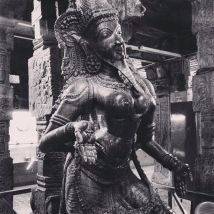
To visit the great temple in Madurai today is to navigate a dozen streets and discover an army of beggars besieging the 700-year-old structure. Some beggars are old, but many are young and quick. There are beggars with bowls, and beggars with babies. But they all have a peculiar confidence when seeking donations. The temple, after all, welcomes about 15,000 visitors on a routine day, and collections from even a fraction of this host are enough to sustain their economy on the streets. The solicitation of money is made with an almost defiant sweetness—if you don’t drop coins, there are others who will.

For all its known history, Madurai has been dominated by this temple, with its 33,000 sculptures and magnificent towers of monumental height. The Greeks traded here and as early as 21 BC, a Tamil embassy was welcomed in Rome. The eunuch general from Delhi, Malik Kafur, came uninvited to relieve the city of its burdensome riches in the early 14th century, and some generations later, Roberto de Nobili showed up seeking flocks of Christians. The Italian convinced local priests that he was from a line of ancient, lost Roman Brahmins, flaunting a sacred thread, and by 1610 teaching the gospel in fluent Tamil and Telugu.

The story of the Meenakshi temple, though, is the tale of a woman—a fearsome warrior queen transformed into a lovable goddess; a formidable mortal tranquillized into divine immortality. The Story Of The Sacred Games (also called Tiruvilaiyadal puranam), a 13th century poem in 64 rich chapters, begins with a melancholy Pandyan king. “I was without a son,” he remembers, “and I performed great sacrifices for a long time. (And when that failed) I performed the sacrifice that was supposed to produce a son.” Soon he received a child, but the three-year-old that emerged from the flames was a girl. “But God!” cried the king, “even though this girl has come with a face that shines like the moon, she has three breasts!”

So it was that Meenakshi—she with fish eyes, a political superlative since the fish was the totem of the Pandyas—made her appearance on earth. Her father worried that her three nipples “will make even enemies laugh”, and languished in “depression and unhappiness”. He had sought a child but what he got was a freak. But a voice from the heavens reassured him and the three-nippled girl was raised as a boy, dissolving boundaries of gender and sex. When (s)he came of age, her parents said it was time to marry. (S)he, however, decided it was time to conquer the world.

With a furious army, Meenakshi set out from Madurai. Indra, Lord of the Heavens, fled at the very sight of his foe—and nobody laughed any more at the third nipple. Soon the conqueror climbed the Himalayas to battle Shiva. But when the fish-eyed one gazed upon him, the third breast disappeared and she became a regular woman. Or as the poem tells it, she “became bashful, passive, and fearful. She leaned unsteadily, like the flowering branch of a tree under the weight of its blossoms. Her heavy dark hair fell on her neck. She looked downward, toward her feet… And there she stood, shining like lightning, scratching in the earth with her toes.”

Soon they were married, and the rest of the poem shows Shiva as its hero, pulling the strings where once his wife had led. It is suspicious how Sacred Games seeks to establish his power, almost as if to compensate for the reality that was the superiority of his wife—to this day, it is Meenakshi who is worshipped first, not Shiva. They share eight festivals, but she has four dedicated only to her while her husband has none. Shiva too, in practice, was Pandyanized. His animal skins were discarded for silk, the serpents he wore replaced by bejewelled ornaments. He is Shiva in name but a different kind of Shiva.

Inside the temple, there are sculptures still of others who, like Meenakshi, were born different. There is a representation of her in stone, all three breasts intact, before her union with god made her more “normal”. There is Arjuna not only as the feared warrior of the Mahabharat but also as Arjuni, in female form, and as Brihannala, in the third gender—he has the face of a man, with a drooping moustache and a long beard, but the body of a woman, with full breasts. Besides transgenders, there is also room in the tube-lit temple premises for autosexuals—the halls feature self-fellating lions, under some of whom sit pilgrims, children, and ticket vendors.

Was there really once an androgynous queen with three nipples whose exploits inspired Sacred Games? Megasthenes, the Greek envoy to India, refers to the legend of a princess wedded to a god, but seeking history in song is a self-defeating exercise. What matters is the devotion Meenakshi inspired then and still inspires today. Some view her marriage with Shiva as the absorption, at last, of a resilient local goddess into the wider Hindu framework, where her independent power was surrendered in favour of a greater cause and more correct femininity. But the pilgrims who come to Madurai to pay obeisance to Meenakshi—not her husband—keep alive the flame of the original triple-breasted warrior.

And like the politely defiant beggars outside, every pillar and stone defies the story woven in Sacred Games in celebration of a memory from long, long before, when the abnormal resisted the normal, and when a princess reigned before she was turned into a goddess.

(My column in Mint Lounge, April 15 2017)

galilieo-kknb-621x414livemint.jpg

If you go to Florence with the twisted desire to behold Galileo Galilei’s remains, there are two places to visit. If your interest lies in withered, physical fragments of genius, you must walk to the Museum of Science where a glass egg holds his middle finger—something he once raised in constructive opposition to the Catholic church—with two other digits and one tooth for company. The balance of Galileo’s body, enclosed in the integrity of a magnificent tomb, lies in the Basilica of Santa Croce, where his shriveled companions range from Machiavelli to Michelangelo (whose corpse “admirers” smuggled from Rome—evidently stealing the dead was acceptable conduct in those days).

The basilica is a spectacular structure in a spectacular city and for 600 years someone or the other was still building it—it was only in 1863 that the marble façade was fixed. I parked myself on a bench outside and read about the great man buried inside, acting with self-conscious decorum before locals sitting on the steps, drinking beer by the evening light. Galileo, at any rate, would not have objected to the alcohol—when, in contravention of sacred, irrational traditions, he wrote The Assayer (1623), a foundational work for modern physics and methods of science, one orthodox critic suggested that perhaps Galileo was suffering from an overdose of wine.

Born in 1564, Galileo was the son of a musician. After a boyhood in Florence, he went to university in Pisa, affronting its masters by demonstrating uncommon intelligence. Acquiring considerable numerical knowledge, he declared that the “book of Nature is written in mathematical language. Its characters are triangles, circles, and other geometrical figures” without which “one wanders in vain through a dark labyrinth” of religious ignorance. Naturally, with outrageous ideas like this, he returned to Florence broke and without prospects. His popularity with students, however, rescued him—Pisa hired him as a lecturer, where he impressed pupils with his contrarian charisma, composing such memorable lines as, “Only wear gowns/if you’re a dimwit who frowns.”

Over the years, Galileo moved about a great deal, struggling to earn a living and to support his mistress. The Medici grand dukes of Florence, whose imprint remains visible across the city, patronized him and, later, extended protection. In 1605 he tutored a Medici and in 1609 he annoyed this Medici’s mother—oblivious to the difference between an astronomer and an astrologer, she commissioned him to produce her dying husband’s horoscope. A debt-ridden Galileo, without irony, accepted, prophesizing a delightfully extended future for the ailing duke, guaranteed by the heavens. As it happened, the man died within the week.

Galileo’s greatest successes did, however, come from the stars. The telescope, invented in 1609, allowed, as R. Hooke wrote, a “transmigration into heaven, even whil’st we remain here upon earth in the flesh”. Galileo developed a model 30 times more powerful than the Dutch prototype to investigate the skies. Soon he showed that the moon was not a smooth, divine orb, but a place with mountains and craters—all the imperfections of Earth afflicted heaven too. He discovered Jupiter’s moons and the phases of Venus, concluding in 1612 that Earth was not the centre of the universe, as certified by the Bible, but that it revolved around the sun with infinite space beyond, of which we were but a tiny fragment.

It was a fascinating time. In 1610, Galileo had published his Starry Messenger (immodestly hinting that his consequence to history was greater than could be commemorated by any memorial now). Thinkers across Europe were animated by the possibilities this opened up. Space travel appeared in Francis Godwin’s The Man In The Moone (1628) and within a decade it was suggested that one day humans would indeed venture beyond Earth. Other works of fiction like The States & Empires Of The Moon (1657)—featuring four-legged aliens and rockets—explored the theory that there might be other habitable worlds out there. This was more than just creative writing: Fiction offered a safer avenue to articulate controversial ideas in the teeth of papal opposition without fearing charges of heresy.

Galileo, however, was hardly the diplomatic type. He began his damning Dialogue Concerning The Two Chief World Systems (1632) on an understanding with the pope that he could articulate his view but must concede that Christian traditions were paramount. Galileo did the exact opposite, and soon found himself tried by powerful men with small minds, contemplating techniques for his liquidation. In the end he was prevailed upon to state that he “abjured, cursed, and detested” his theory of Earth’s revolution around the sun, muttering “but it still moves” defiantly under his breath. Partly because there were sympathetic factions within the church, it was decided that the man would not be roasted. He was to spend the rest of his days under house arrest.

When old, blind Galileo died in 1642, the Medici sought to bury him inside Santa Croce beside other great sons of Florence—the pope objected and it would take 95 years of persuasion before the remains were installed inside the basilica. My own visit to Santa Croce ended in disappointment, though—the doors were shut and I couldn’t enter to view the spot where Galileo lies. I had to satisfy myself through a picture pamphlet instead. Rising from the bench outside and from the gaze of the beer drinkers, I performed a perambulation of the building; a consolatory revolution of my own around the resting place of the man who revealed to us science’s great truths, toppling, in the process, God and God’s voice on Earth.

(My column in Mint Lounge, April 08 2017)

mg_4138a.jpg

By the time of his demise in 1906, critics were convinced that Ravi Varma would feature right on top of the “rubbish heap” of Indian art. To Aurobindo, he was “the grand debaser of Indian taste and artistic culture”, a “superstition” that “received its quietus” at last in death. To Ananda Coomaraswamy, who allegedly based his denunciations on Varma’s prints rather than actual oils, his “fatal flaws” were “theatrical conceptions, want of imagination, and lack of Indian feeling”. The gods Varma painted were “in a very common mould”, aggravated by the “unsavoury” singers and prostitutes on whom they were modelled. Sister Nivedita found Shakuntala profoundly “ill-bred”, fuming that thanks to Varma, “every home contains a picture of a fat young woman lying full length on the floor writing a letter on a lotus leaf”. His paintings were indecorous, imitative, and simply not real art—they belonged on the cheap calendars where Varma himself apparently doomed them forever.

While price tags aren’t a dignified vindication of the value of any creative work, the auction of Varma’s Damayanti in New York recently for $1.6 million (around Rs11 crore) is a plausible indicator that a century after diabetes rested his brush, the artist retains appeal among more than just connoisseurs of calendars. His romantic Indian themes, immersed in mythology, were one reason for his immense popularity but “the appeal of his heroines”, Partha Mitter wrote, “lay in the fact that they were not iconographic types, but palpable, desirable human beings”. Then there was the historical period during which he crafted his reputation—nascent nationalism made his oleographs of Shivaji a rage in Maharashtra. Brahmins visited his studio to “gaze in wonder” at his splendid canvases, and poorer homes acquired prints of gods they worshipped but could never visualize—not at affordable prices anyway.

Interestingly, as Vidya Dehejia noted, Varma was “the progenitor of fair skin as an ideal of feminine beauty in Indian popular visual art”, an innovation favourably received in colonial times, penetrating masses of minds through Varma’s lithographs. He was, in this respect, influenced by un-ancient yardsticks. On the one hand, it was his aristocratic roots that steeped him in Sanskrit tales of Draupadi and Radha. But, on the other, when he portrayed these protagonists on canvas, attributes were altered to fit conventions of the day. Unlike old sculptures, they could no longer be scantily clad, and so appeared exquisite drapery. And unlike ancient poetry—from Kalidasa to the Kamasutra—they could no longer be dark-skinned, since that ideal had made way for the model of fairness. So it was that his Damayanti and Shakuntala were paler than their literary ancestors—dark strokes were reserved for lower-class women.

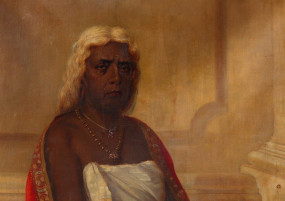
My own favourite Ravi Varma, however, is an obscure canvas that features a decidedly upper-caste woman of redoubtable bearing, confident in her darkness and the authority with which she occupies the frame. Glaring at the viewer (or perhaps the painter who presumed to deem fairness a requisite for beauty), this is a formidable woman who towers over the pale faces populating Varma’s better-known paintings. The difference is that this is a portrait, but while Varma ordinarily flattered his patrons by enhancing their attractive features, this one is marked by originality—he daren’t take liberties with a single characteristic of his uncompromising subject.

Her name was Mahaprabha, daughter of Chamunda. Married to an uncle of Varma’s, she was a descendant of kings, and mother of queens. But for our purposes Mahaprabha can be identified primarily as Varma’s mother-in-law—the woman with whose daughter he had a troubled marriage (which forms a significant narrative component in an awful biographical film that countered Varma’s heights of feminine beauty by depicting him as a muscular flirt with a shaved chest). Mahaprabha was, in family circles, believed to be precisely the kind of woman her painting shows her to be. “All were in awe of her and she was feared and respected,” remarked a descendant to me, and “her opinions were never refuted as none dared contradict her views”. Varma painted her as she was, without softening her piercing gaze and pronounced features.

Lambasted by J. Swaminathan for his “vulgar naturalism”, Varma was actually not from a world of fair women in silk saris writing letters and awaiting lovers—his mother was dark, regal, and an accomplished poet. His wife and her royal sisters were not fair, but were attractive women of personality (with the capacity to flout rules—Varma’s wife acquired an “addiction to drink” despite orthodox settings). Yet the growing preference for fairness took root among them too, hastened by his brush. His older daughter modelled for him thanks to her fine features and complexion (though he toned down the authority writ across her face to produce a delicate air), while a dark-skinned second daughter was destined to live in her sibling’s shadow, considered less beautiful, though not less headstrong and powerful.

There is splendour and beauty in Varma’s mythological creations like Damayanti, and these played a role in the modern re-conception of our pre-modern past, shaping nationalism and cultural confidence in a colonial age. But the portrait of Mahaprabha represents the reality of the world that created the painter—a world with a different aesthetic, not suited for pan-Indian appeal, but singularly striking. While Varma’s work is dismissed as kitsch, this is a painting that stands against his own idealizations—the woman here is not coy; she is firm in her gaze. She is not dainty, but full of force. She is real and not amenable to artistic manipulations of form and colour—it is the background he made pale, not the woman’s skin. And this very manifestation of her reality makes her, to me, more magnificent than Varma’s breathtaking mythological canvases.

If one day Mahaprabha appears at auction, I wonder what value they would assign her. For she goes back to the time before Varma gave us the cultural imagery for which he is celebrated, to a time when he had no freedom to represent truth with romance, and had to paint in oil reality as reality was, big nose, dark skin and more.

(My column in Mint Lounge, April 01 2017)

maxresdefault.jpg

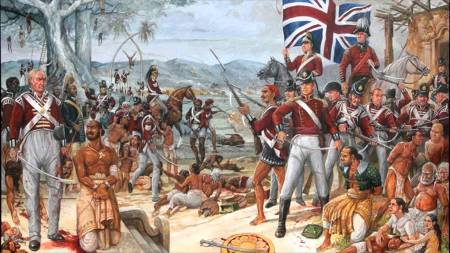
The appearance recently of a series of books on India and the Raj shows that the history of empire is once again in fashion. There is Jon Wilson’s magisterial India Conquered, which investigates the manufacturing of British power in India, and Ferdinand Mount’s The Tears Of The Rajas, which explores its traumatic corollary. Shashi Tharoor delivers a withering review of colonial exploitation in An Era Of Darkness, while Walter Reid, in Keeping The Jewel In The Crown, exposes British perfidy in the closing chapter of Pax Britannica. Most of these books succumb, however, to sometimes painting history in black and white—Curzon, as this column has argued before, earned points as a villain for partitioning Bengal, but it was also he who restored India’s monuments and preserved our historical heritage.

It’s a slippery proposition, but what character might India have developed had the British never prevailed? Would the south have existed as an autonomous unit, possibly under French influence? After all, by the mid-18th century the French had booted the English even out of Madras, and established a robust peninsular presence. The chief of Pondicherry was dignified by the Mughal emperor as a nawab and managed to keep the Marathas at bay (apparently by plying the commander’s lady with alcohol). Tipu Sultan was a friend of the French, and had it not been for revolutionary convulsions in the 1790s that preoccupied his allies overseas, he might have received the assistance he needed to vanquish the British. More endearingly, Tipu entertained plans to educate his sons in France, and given his interest in engineering, the fruits of the Industrial Revolution may well have found their way to Srirangapatna via Paris. As it happened, the French enterprise collapsed, and the English claimed supremacy.

It was the entrenchment of British power that made racism state policy; this could, perhaps, have been averted had Indians retained power, dealing with Europeans from positions of strength, confidently commissioning Western talent for indigenous purposes—it was a German who commanded the Marathas at Assaye, and in Kerala it was a Dutchman who modernized Travancore’s armies. The nautch girl turned begum of Sardhana had tragic romances with a Frenchman and an Irishman. Such exchanges were a two-way street—in the early 19th century, Tamil devadasis performed in Europe and Kalidas won Western admiration when his Shakuntalam was staged in London as Sacontala. Racism reversed this, but if the politics behind racism had itself been avoided, things might have been happier.

Not everything, of course, would have emerged perfect even under Indian rule—caste, for instance, would have remained a deep-rooted obstacle to the dawn of any sense of nationalism. Politically, by the late 18th century, the Marathas dominated north India, from Lahore in the west to Bengal in the east, and a line of Shivaji’s family ruled in Tanjore, deep in Tamil country. But while the Marathas might have united much of India, had the last Anglo-Maratha War in 1818 not culminated in defeat, they would have had a long way to go before they could claim the loyalty of India’s diverse peoples. After all, it was raiding rather than governing that animated them, and as the Maharashtra Purana noted in the context of Bengal, “When they demanded money and it was not given to them, they would put the man to death. Those who had money gave it, those who had none were killed”—hardly a promising formula to inspire brotherhood and patriotism.

The irony, contested as it is, is also that it was a common hatred of the English that energized feelings of Indian unity. And that it was a foreign language that allowed a Mohandas Gandhi from Gujarat to mentor a Jawaharlal Nehru from Allahabad, collaborate with Tamil-speaking C. Rajagopalachari, and debate with the Bengali Subhas Chandra Bose. Indeed language would have been another interesting twist if the British had never reigned. English was imposed officially in 1837, before which it was Persian, now dead here, that served as the lingua franca of officialdom across much of the subcontinent. As one 1858 report noted, Persian was “for 600 years the language of justice…the language of the Court…(and indeed) it was much better known even than the English language is at present”. It was used in Nepal and fragments of it were employed as far south as Kerala. If English had never picked up, India’s elite may still have been speaking to one another, across divides of region, religion and language, in an equally foreign tongue born in faraway Iran.

So instead of the succession of East India Company rule by the Raj under maharani Victoria, India might have come into the 20th century with a figurehead Mughal badshah, presiding over a Persian-speaking bureaucracy, supervised by the Marathas, with diplomatic dealings with a French-influenced south. Like foreigners before them—from the Arabs and Jews to the Turks and Central Asians—the British, Germans and French would have been absorbed into local society, through inducements of marriage and employment. Indian philosophy would have proudly travelled beyond its frontiers, and ideas from the rest of the world would have received a welcome in India too.

All this, of course, is one grand hypothetical proposition, fraught with perils. But while we increasingly investigate the impact of the Raj in shaping modern India, one hopes to be forgiven for wondering what the land might have looked like had the English never claimed dominion, and demeaned India as the jewel in a foreign monarch’s crown.

(My column in Mint Lounge, March 25 2017)

1369381673_78291.jpg

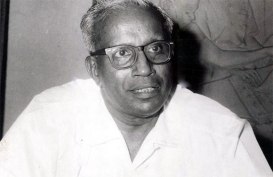
The world into which Sankaran Namboodiripad arrived in 1909 was flooded with gods. There were important gods for men and less important gods for women, all stationed inside the house. There was a friendly goddess who lived above the portico, and a terrifying goddess restrained on the first floor of the outhouse. Their daily fare included “blown rice, then cooked rice and, in the end, milk porridge” and, now and then, the gods possessed an oracle to make their views heard. Even distant gods in faraway temples deserved acknowledgment—first everyone prostrated for all the grand gods; then they fell flat on the floor in the name of the household gods; and in case some god or other was accidentally omitted, a “compensatory prostration” followed to ward off divine wrath.

As a Brahmin man in Kerala, Sankaran could expect to live in near opulence. Cushioned by their deities, the Namboodiris “occupied the highest position among all other communities and castes, collected fabulous amounts as rent, enjoyed undisputed supremacy over the tillers of the soil, and maintained intimacy with the ruling monarchs”. There were processions of parasol-wielding servants but modernity meant that there was also a motorcar at Elamkulam Mana, Sankaran’s ancestral home. Every time it was used, though, a dip in the pond was warranted to wash away the ritual pollution that invariably accompanied Western inventions. Sankaran could also have acquired a series of wives—his father had two, and four of his sisters were married to men who were not single. One cousin had two ladies, and after the wedding of his daughters, this specimen proceeded to espouse a third.

It was the Moplah Rebellion of 1921 that changed everything—Sankaran’s family retreated from their rural cocoon to the sanctuary of an urbanizing locality, exposed for the first time to Western-educated crowds, children playing football, people sipping tea, and Brahmin men in English shirts (the first Brahmin woman to wear a blouse in Kerala was ostracized because, surely, only a harlot would feel an impulse to cover her breasts in a land where toplessness was uniform). “An ambition rose in my mind,” Sankaran later wrote, “that one day I should also go to school…and imbibe the modern refinements which were an adjunct of school education.” He did go and became a fine student, failing only in art. “But then, the marks of drawing were not counted in the final examination, and as such it did not worry me.”

School and college allowed Sankaran to involve himself in the reformation of his caste, initially through such curious articles as “French Revolution And The Namboodiri Community”. More seriously, he began to argue for the rights of Brahmin women. They, including his mother, were antharjanam (literally, indoor-people), the only women in Kerala who lived in purdah. Soon, in his own scattered way, he was protesting Bhagat Singh’s death sentence and championing Mahatma Gandhi’s civil disobedience movement, and in 1932 he was arrested for the first time. To a Namboodiri, this meant irretrievable loss of status, but Sankaran, already written off as a rotten egg, was surveying other characteristics of the experience. Prison, he pithily wrote, “could compare well with…a hostel except that there was no freedom to go out of the jail compound”.

By the mid-1930s, Sankaran had veered towards the socialist camp within the Congress, and despite a stint with the Kerala Pradesh Congress Committee and election to the Madras legislature, he wasn’t convinced by Gandhi—the Mahatma might achieve political freedom, but what about social liberation and freedom from the bondage of class? “The tortuous path which took me from the original moorings of the feudal family into which I was born, and from the old-fashioned education to modern education and the organized movement of social reform, and ultimately to nationalism with its leaning towards the left…at last culminated in my membership” of the Communist Party of India. The year was 1940, and Sankaran emerged as the E.M.S. Namboodiripad the world would remember.

His Brahmin heritage became a thing of the past—EMS began to work with Dalits, fishermen and labourers, becoming “the adopted son of the working class”. Romance aside, in 1947 he put his money where his mouth was, selling personal property to resurrect a party mouthpiece. Ten years later, after independence and a sustained political movement, he was sworn in as the first chief minister of Kerala, in 1957. Jawaharlal Nehru was not immediately alarmed at the prospect of a Commie in power, noting that EMS had, for all his stammering rhetoric, put on “the most proper and decorous constitutional clothing”. But behind it all, EMS’ intentions were fixed in red—it took one week for him to promulgate Kerala’s historic land reforms, arguably his most significant achievement.

Predictable opposition followed, and in the next two years, a law and order crisis overwhelmed Kerala—or was manufactured to justify the imposition in 1959 of President’s rule. “Everything looks yellow to a jaundiced eye,” EMS ruminated after the dismissal of his government, adding wryly: “It is not violation of ‘democracy’ and ‘free enterprise’ for the landlords to own several thousands of acres of land in the very village in which there are hundreds of families with no land at all…. But it is a violation of ‘democracy’ and ‘free enterprise’ if the Government enacts a law according to which these thousands of acres of land…are taken over and distributed among the landless.” He refused to be cowed, and 10 years later, during his second stint in power, land reform became a reality.

His fellow Brahmins were horrified—many of them were impoverished overnight. It was harsh and much went awry, but for masses of people, it was the correction of a historic wrong. The Namboodiris justified their grip over land in Kerala through the myth of Parasurama, an avatar of Vishnu, who is said to have reclaimed the coast from the seas and presented it to Brahmins for eternity. There was poetic justice that, centuries later, it was a Brahmin who handed land back to those who tilled it—those who evidently had no place in Parasurama’s scheme but were taught to view the Brahmin as “their royal liege and benefactor, their suzerain master, their household deity, their very God on earth”. To EMS himself, whose death anniversary Kerala observed last weekend, there was little irony in all this when life itself was one elaborate irony.

He was born in a household where the gods reigned, eating rice and milk. He ended it as a rationalist, with no gods for company and quite a different kind of menu. A journalist, following a meeting with Nehru, asked EMS what the prime minister had served for lunch. “Exactly what a good Kashmiri Brahmin should offer a good Namboodiri Brahmin from Kerala,” laughed the Commie—“fish, meat and chicken!”

(My column in Mint Lounge, March 18 2017)

george_nathaniel_curzon_by_john_singer_sargent_1914.jpeg

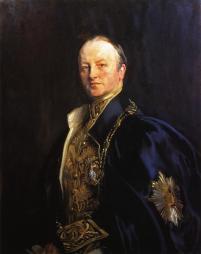
Narendra Modi, who looms larger than ever in fashioning a Congress-muktBharat, might be interested to learn that the last person to envision such a universe was a staid white man from an island called Britain. While for Modi it is dramatic electoral victories that pave the way, it was the factional feud between the moderates and extremists in 1900 that the viceroy, Lord Curzon, hoped would extinguish the Congress in his time. He didn’t make Modi-style speeches but, writing to superiors in London, expounded his “belief that Congress is tottering to its fall”, adding how “one of my great ambitions while in India is to assist it to a peaceful demise”. He spent six years investing precisely in this ambition, only to withdraw frustrated—the Congress took a deep breath and resurrected the freedom struggle. Today, deep inhalations won’t suffice. And thanks to Modi, the drowning gasps of the Congress may well be offering dear old Curzon belated graveyard consolations.

Like our resolute Prime Minister, Curzon too ruled India with self-appointed purpose. That it was the wrong purpose altogether is another matter, but his conviction was unparalleled. He always had a sense of his importance, and made every effort to flaunt it. At Oxford, his peers came up with the doggerel: My name is George Nathaniel Curzon/I am a most superior person/My cheek is pink, my hair is sleek/I dine at Blenheim (Palace) once a week. It didn’t help that he also had that disagreeable habit of passing judgement everywhere he went. On a trip to Canada, he sniffed how there were few well-bred passengers on board, and the “social status of the remainder is indicated by the aristocratic names they bear—Tulk, Tottle, and Thistle”. As it happened, he married a blacksmith’s descendant called Leiter, a match not too repulsive after the little matter of a not-too-little dowry was discussed.

It was India, though, that made Curzon—and unexpectedly so. “From nobodies,” his American wife exclaimed, “we have jumped into grandeur.” Only 39 when he was propelled into his “civilizing” viceregal mission, Curzon couldn’t stand the demands of the “native” elite for a share of power and a fraction of respect. The princes he dismissed as “a set of unruly and ignorant and rather undisciplined schoolboys”, while the Congress was a “microscopic minority” of jobless lawyers, completely divorced from reality—a sentiment with which many might relate today. “You can as little judge of the feelings…of the people of India from the plans and proposals of the Congress party as you can judge of the physical configuration of a country which is wrapped in the mists of early morning, but a few of whose topmost peaks have been touched by the rising sun.” This Curzon declared before he ever set eyes on a Congressman.

He did, however, show empathy for ordinary people, partly because in those days, ordinary people didn’t ask inconvenient questions. When British soldiers raped a Burmese woman, he was horrified by the conspiracy to protect them—the entire regiment was expelled to Aden, “the worst spot I could find”. When a planter flogged his Indian servant to death and escaped a harsh sentence, Curzon appealed for real punishment. “I will not,” he wrote, “be party to any scandalous hushings up of bad cases…or to the theory that a white man may kick or batter a black man to death with impunity because he is only ‘a damned nigger’”. The English, he argued, must set an example in India by their “superior standards of honour and virtue”. While he personally went about setting examples, other Englishmen continued to kick Indians, calling Curzon a “nigger-lover”.

Good intentions aside, Curzon was also the kind of man who centralized power and reigned over mountains of paper. “The Government of India,” he mourned familiarly, “is a mighty and miraculous machine for doing nothing.” His solution, though, was not to empower Indians, but to pile up more on his own imperial plate—on one occasion, the viceroy himself set out to catch a chicken-thief when accounts did not add up in the stately kitchens of what is now Rashtrapati Bhavan. He couldn’t quite understand why the Indian education system—of his own people’s design—was so focused on manufacturing a “rush of immature striplings” interested “not to learn but to earn”. He made attempts to develop a research-oriented university system and emphasize technical education, though in implementing these wonderful ideas he again forgot to involve those brown people for whose benefit they were intended in the first place.

What most offended everybody, however, was Curzon’s notorious partition of Bengal. He had already carved the North-West Frontier Province out of Punjab, and had plans for Berar, Orissa, and other provinces as well. As the cradle of Indian nationalism, however, Bengal was unique. Despite mastering the principle of divide et impera, London warned Curzon not to proceed because “the severance of old and historic ties and the breaking up of racial unity” would backfire on the Raj. But he went ahead anyway—and lived to regret it. The partition, to begin with, settled the internal doldrums of the Congress, rallying all factions against this single cause. Curzon, who in 1904 began a second term, was recalled within 12 months into a future with no more spectacular prospects. By the time of his death this month 92 years ago, he was reduced to complaining how not enough people were visiting to check on his welfare. “I must be entirely forgotten,” he lamented, “or have no friends left.” Both were partially true.

There is, however, one thing for which Curzon deserves lasting credit: his genuine interest in preserving India’s monuments, a responsibility “scandalously neglected” till then. When some complained that he was protecting “pagan” structures, he reminded them that as sheer manifestations of human genius, to him “the rock temple of the Brahmin stands precisely on the same footing as the Buddhist Vihara and the Mohammedan Masjid as the Christian Cathedral”. Personally touring swathes of land, climbing up hills and down ruins, Curzon ensured that the Archaeological Survey of India began to do its job. And for all his prejudices, this one contribution was enough for Nehru, no great admirer of friendless, resentful Curzon, to later remark: “After every other Viceroy has been forgotten, Curzon will be remembered because he restored all that was beautiful in India.” That, one hopes, would give Curzon some more gratification than reports of the Congress’ imminent demise.

(My column in Mint Lounge, March 11 2017)

jamshedji-tata-e1457785933386.jpg

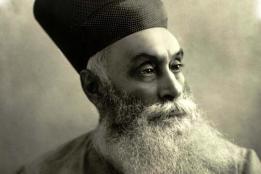
The Pakistani writer Bapsi Sidhwa, dwelling on the perpetual reproductive deficit vexing her endangered Parsi community, once chuckled: “Half the Parsi men are homosexual and the other half are statues in Bombay.” Last week saw the 178th birth anniversary of one of the more celebrated of these statues, a man who not only contributed to the Parsi cause by fathering two brilliant sons—like him, knighted by a king enthroned in a faraway island—but who also made some of the most enduring contributions to the material reinvigoration of India after its industries were systematically smashed in the name of that very king in times before.

Jamsetji came from a line of priests 25 generations old in Navsari in Gujarat, though it was after 11 generations of ministrations there that they took on the surname “Tata”, destined for glory in the 20th century—and perhaps an awkward display of corporate discord lately in the 21st. Jamsetji would have become a priest had he not studied in what is now Mumbai, a city to which he made very many contributions, and where he elected to turn his decidedly astute head towards business, not god. He was a clever man and accumulated vast riches, most of which were invested in regenerating this growing fortune and distributing its yields generously.

He was also a man of vision. As one biographer noted, when Jamsetji was born in 1839, the world was still in the grasp of a generation that belonged to the 1700s. It was a time when bullock carts transported merchandise and stage coaches lugged human beings. In his lifetime, he witnessed the historic upheaval of 1857 as well as the arrival of motorcars and the railways. Sometimes with camels and donkeys as his mode of transportation, he travelled in countries as alien as Egypt and Russia and to places as distant as Shanghai and South Carolina. Everywhere, he absorbed ideas and innovations, proceeding to painstakingly incarnate them in his own land.

This, for instance, is what made him the first in Bombay to fit rubber around his carriage wheels, stunning masses of people with the stately quietness of his vehicular progress. It is what inspired him to pursue with vigour, and against all odds, the establishment of Tata Steel (when bureaucrats scoffed that they would eat every ounce of steel an Indian could produce) and the endowment, at considerable personal expense, of the Indian Institute of Science (IISc), now ranked the eighth leading small university in the world. By 1924, one in five Indian civil service officers of “native” origin had had his training sponsored by Tata, and it was Jamsetji who first instituted pension funds and accident compensation, and installed humidifiers and anti-fire sprinklers, for the welfare of his factory workers.

It was this same spirit that led to the establishment of the Taj Mahal Palace hotel, mocked instantly as “Tata’s White Elephant”, but which has become an iconic symbol of the city of Mumbai and of India itself. Jamsetji exasperated legions of imperial worthies with his untiring missions—Lord Curzon once irritably remarked that he was “endeavouring to save Tata’s scheme from the shipwreck which (are) his ambitions”. Indians, on the other hand, admired him for precisely such ambition. Years later, Jawaharlal Nehru remarked that Jamsetji “formed himself into some kind of a planning commission”, not with a Five-year Plan “but a much bigger plan”, for posterity itself.

There was dignified patriotism too in Jamsetji, who was present at the 1885 inauguration of the Indian National Congress and who once alarmed his fellow rich by suggesting a then unheard of income-tax rate of 20% on their kind. Once, when lambasted for disloyalty by a prominent colonial mouthpiece after he questioned British policy, Jamsetji responded by admitting that while the Parsis had indeed “benefited more than any other class by English rule” (and the opium trade) and would demonstrate gratitude “in due proportion to the advantage derived”, “it must not be forgotten that as much is due…to the people of this country which gave (this community fleeing Iran) shelter for centuries before” the advent of the Raj.

This was not to suggest that the Parsis lived on anybody’s charity in India. This, he knew, was a land of diversity, and even his sense of aesthetics (while abhorring “abominable yellows and reds as much as possible” in household furnishing) reflected this. When plans were formulated for what would become Jamshedpur, the man wrote to his heir: “Be sure to lay wide streets planted with shady trees, every other of a quick growing variety. Be sure that there is plenty of space for lawns and gardens. Reserve large areas for football, hockey, and parks. Earmark areas for Hindu temples, Mohammedan mosques and Christian churches.” Everything—from secular spaces to religious establishments—and everyone had a place in his conception of a modern Indian city.

When Jamsetji died in 1904, most of his pet projects were still in the making—it would be eight more years before the Taj Mahal Palace ceased to be a white elephant and stood on its own feet, and seven before the IISc began its remarkable journey. It was four years after his death that the construction of Jamshedpur began, with those avenues, parks and places of worship that he recommended. Jamsetji himself couldn’t behold the fruits of his labour and the outcome of his vision. But it doesn’t seem to have mattered to him.

In addition to his big statue in Mumbai, there is one in Jamshedpur, marked with a plaque bearing famous words borrowed from the tomb of Sir Christopher Wren, the architect: “If you seek a monument, look around.”

(My column in Mint Lounge, March 04 2017)

aurangzeb-1.jpg

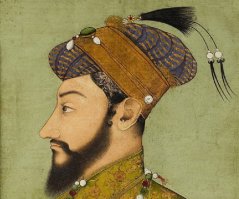
Some days ago, Emperor Aurangzeb—recently toppled from the towering heights of a Delhi signpost—found his way to the more untroubled comforts of my bookshelf. The woman behind this restoration is Audrey Truschke who, when not exploring the place of Sanskrit at the Mughal court, is evidently part of a cabal of “soul vultures”, according to one furious local website. They have reason to dislike her. After all, Aurangzeb—Muslim tyrant, persecutor of Hindus, stitcher of skull caps, etc., etc.—deserves no honour. And writing a book called Aurangzeb: The Man And The Myth concedes too much dignity to a despot who deserves only contempt. Or so we are told.

In itself, this very contested setting makes the prospect of reading Truschke attractive, but if one is looking for overblown sympathy that projects Aurangzeb as a tragic hero (currently a place reserved for his slaughtered brother, Dara Shukoh), this isn’t the book. On the contrary, what we receive is a sequence of sober, unvarnished sentences that demolish political propaganda and show Aurangzeb as a man who certainly made many mistakes, but not the ones for which he is blindly condemned. To begin with, he was not the destroyer of “thousands” of temples—in his 49 years on the Peacock Throne, the number of shrines demolished was perhaps half that figure.

“Aurangzeb was an emperor,” Truschke writes, “and as such he needed no special justification for seeking to enlarge his empire.” I confess to liking this otherwise dry statement, for in one stroke it puts the man in the correct perspective—he was a despot, but he lived in an age of despots, answering to the demands of his own situation and not to the retrospective needs of ours. Dara Shukoh, his more amiable, philosophically inclined brother, would have been relatively heterodox perhaps, but even he admitted that had he won the war of succession, Aurangzeb would have been neatly chopped up and put on display in Delhi. “Either the throne or the grave” was the reality of the Mughals, and the most excellent of them lived by this dictum.

Truschke agrees that Aurangzeb was a a clever strategist but a bad ruler—he stretched the empire to unsustainable limits and on his deathbed was preoccupied with the inevitable unravelling of his house. His unnecessary imposition of the jizya tax on Hindus (from which Rajput and Maratha officials as well as Brahmin dignitaries were exempt) only lined pockets in the decaying bureaucracy. For years he patronized temples as far away as Guwahati and later rescinded such orders when his princely mood turned. He allied with mullahs where it served his purposes, and discarded them when it didn’t. Leading clerics, for instance, opposed his usurpation of the throne. Aurangzeb simply had them replaced.

Understandably, it was insecurity that guided his strange actions. When he took the title Alamgir, the Shah of Iran sniggered that “Seizer of the World” was somewhat exaggerated when the only thing Aurangzeb had seized was his own father. As Truschke states, “Being branded an illegitimate Muslim monarch likely prompted Aurangzeb to become more devout…. Here, Aurangzeb’s religiosity did not shape state policy so much as his kingly experiences inspired changes in his religious life.” He appropriated religion to invent legitimacy—a technique not unfamiliar to rulers from other faiths—but if conflict arose between Islamic ideals and imperial business, it was the latter that prevailed. When the mullahs objected to his war against Muslim sultans in the Deccan, Aurangzeb ignored them.

Truschke also insists that we must not hold Aurangzeb up to Akbar since “in such comparisons we also commit the classic error of assuming that everything in Indian history, especially the Indo-Muslim past, was about religion”, where Akbar becomes the “good” Muslim whom Hindus respected, and Aurangzeb the “bad” one everyone resented. Aurangzeb was generally austere—he restricted Holi celebrations, but also festivities around Muharram and Eid. The love of his life was a Christian, and for a man who didn’t permit music in his presence, his companion towards the end was a musician wife. His daughter was a poet and his uncle, Shaista Khan (a villain for the Marathas), composed in Sanskrit. If we must compare him with Akbar, it is instructive that Hindus comprised 22.5% of all the nobility under the former, while during Aurangzeb’s time the number reached an unprecedented 31.6%.

It is a deathless travesty that political interests today draw nourishment for current interests from decontextualizing history, without actually going through the effort of learning enough of it. Aurangzeb occupied a complex world with competing interests and changing personalities—the scheming prince who took the throne in 1658 was not the emperor who died in 1707, fearing the advent of ruin. He probably realized he had failed, retiring to an unmarked grave, hoping possibly to be forgotten. But those who came after him are unwilling to let him go—from 300 years ago, Aurangzeb is dragged into the battles of the present, waged in school textbooks, and in the naming of roads. That, perhaps, is the fate of all emperors but thanks to a “soul vulture” called Audrey, we can at least now view the man in his own context and in the terms of his time.

(My column in Mint Lounge, February 25 2017)

I spent last weekend in Germany, surveying some hugely interesting people. I ran into a beaming David Miliband in the elevator, and relished Boris Johnson being told off for saying, predictably, something silly. While John McCain rushed past, there was at least one distressed Royal Highness looking for a seat. President Petro Poroshenko of Ukraine delivered a deliciously devastating punch on his counterpart in Russia, while US vice-president Mike Pence reassured his nervous European allies that America will not seek a divorce from their doddering transatlantic union—unconvincing, of course, given the drivel that pours out from @realDonaldTrump battering this marriage. When the Chinese foreign minister championed renewed commitment in the globalized world order, irony retreated behind those protectionist walls that architects of this very order now chaotically scramble to build.

The scene was the Munich Security Conference, where droves of powerful men in dull suits have gathered for 53 years to protect, essentially, Western pre-eminence in the world—a pre-eminence sliding slowly down the wrong side. Nowadays, refreshing numbers of powerful women also come, ranging from Anne Applebaum, who brought with her Pulitzer-quality Twitter commentary, to, of course, German chancellor Angela Merkel, who delivered an unglamorous, sensible speech. There were, however, four women whom I met with a small cohort, all of them remarkable not only because of their mandates, but also because of what they represent—if only there are more women doing the talking, the world might come up with those urgent innovations of thought and method that it so desperately needs.

There are in Europe today over half-a-dozen female defence ministers. I met the charismatic Ursula von der Leyen of Germany, a slight figure surrounded by uniformed generals with formidable noses. Chatham House rules preclude recording what we discussed, but I think I will be excused for repeating her advice for women in international relations—be a woman, think like a woman, and don’t turn into a man. Von der Leyen knows what she’s talking about, because she inhabits a critical ministry in a country that is central to Europe’s destiny, a country that has painfully reconciled to its own dark history, and is uniquely poised to remind us of what is at stake if the world excuses the aggressive hyper-masculine rhetoric erupting everywhere. She is a senior political leader in the world—and her experience as a woman is central to her vision.

Female political perspectives differ from those of their male interlocutors’, who, broadly speaking, rarely see things except from one privileged side. This is not to say that the male view lacks value or is unlayered—it is, however, so pervasive that it can suffocate with tedium and homogeneity. Men, if they can look past their noses, will agree that women bring much needed originality to the way things are done—perhaps men should sometimes think like women. There was in Von der Leyen’s style, for instance, something visibly easy and direct in comparison with the intelligent but stiffly starched men sitting by her. Not only was there palpable admiration for her mind, there was also respect for her refusal to “be a man” in the way she discharges her duties. Her femininity informs her work, and in a stagnating male-dominated universe, this is energizing.

Norway too, with its celebrated model that combines welfare with wealth creation and human rights, has a woman at the helm of its defence. Ine Marie Søreide is just on the other side of 40 and came without generals—I imagine demonstration of power through retinue is an affliction she has escaped, and she discarded protocol and got straight to business. After discussing Nato, security strategy and the future of the European Union, I saw her afterwards, sipping coffee in the lobby, giggling with some other women. Stiffly starched men could also learn to giggle now and then. So too came the chief prosecutor of the International Criminal Court focused on her mission, and who brings to her office not only education, ability and legal brilliance, but also her experience as a black woman in a society designed for (white) men. If a new world order is to be built, people like her must be among its architects.

Just before our meeting with the chairwoman of the Chinese foreign affairs committee, my own prejudice made an appearance, mixing mulishness with other embarrassing predispositions. China, after all, is not a country India is comfortable with. I had, at some level, decided that the engagement would be boring, and that this lady would parrot something un-enlightening. When Madame Fu Ying began to speak, however, it was to me the first time that Chinese foreign policy was articulated with large doses of what can (somewhat problematically) be called grace—and it was articulated strikingly well. I didn’t buy the substance of many answers, but we wanted to listen to this spokesperson for the People’s Republic. And that is the mark of any spokesperson’s success in presenting her country’s position to the world. It was a sentiment shared by others around that table, like me reinvigorated by this leader who came with no chips on her shoulder.

I encountered very many interesting people in Munich over the weekend but left with my mind fixated on the untapped promise of women in corridors of international power—to talk, to participate, and to lead. Powerful men in dull suits must urgently make room. For it is already too late and we have many crises to deal with, including one called Donald.

(My column in Mint Lounge, February 18 2017)

20121103_144854.jpg

Sasikala V.K., understandably, was condemned for years as a sinister influence around the late lamented Jayalalithaa, and efforts to park her in Amma’s hallowed post in Tamil Nadu have come, at last, to naught—the Supreme Court has identified a less gratifying location for the lady, famous mainly for possessing endless reserves of nephews, stout with rowdy power and stockpiles of oddly acquired wealth. Tamil Nadu, always a most fascinating political landscape, is now going through yet another interesting (and, I daresay, entertaining) phase, and O. Panneerselvam, a dutiful cipher if ever there was one, appears determined to carry the day. For whom is, of course, another matter.

The weight of her “disproportionate assets” has finally sunk Sasikala for the predictable future but while drama plays out on the east coast of India, I am reminded of happenings on the west coast many decades before, also featuring shadowy figures haunting the corridors of power. A century ago in Kochi, for instance, a raja succeeded to power. He was an intelligent man but age had blunted his previously sharp capacities. Within a few years into his reign, he grew ill and unable to exercise the power and judgement his position demanded. Some say he was more interested in the art of conversing with lizards, but more considered documents tell us that as the ruler retreated into fits of giggles and incoherence, his “consort” picked up the sign manual.

In matrilineal Kerala, the raja’s wife was not his queen—she was only the consort, who could live in conditions of borrowed glory during the lifetime of her exalted spouse but had to retire to her original circumstances after his death. It was the raja’s sisters and their children who succeeded him in the royal line, his own issue treated only as ordinary subjects. If a ruler were wise, he would make arrangements for his lady to carry on in comfort, if not opulence, and find his sons respectable vocations as contractors or doctors or lawyers. Either way, the wife and her household were the king’s private affair, and they had no business or stake in matters of state and policy that concerned the matrilineal ruling dynasty.

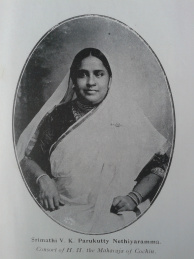
This particular consort, however, rose to fame as the real power in Kochi between 1914 and 1932, by which time her husband was practically senile. Parukutty V.K. wasn’t a bad administrator, but brooked, evidently, no opposition to her “ruling passion”, which was “the acquisition of wealth for her already wealthy family”, in the words of the watchful British Resident at court. The land her husband “gifted” her, for example, was sold back at a premium, after which it was “leased” on a discount by the lady. None of this was strictly illegal but it was deemed singularly inappropriate. The ruler’s ministers objected, not to speak of the royal nephews, but the consort and a loyal palace manager controlled access to the decrepit raja and, in this fashion, retained their grip over the decisions he took and the orders he signed.

This was hardly unprecedented. Further south in Thiruvananthapuram, the local prince had fallen in love with a very married commoner. Her husband, a low-level palace employee, relinquished her to his sovereign, compensated in return with the loftiest title in the land and permanent influence for decades. It didn’t matter that he was publicly embarrassed in stiffly starched society as the “former husband of the maharaja’s present wife”. After all, he had also been installed as palace manager, which supplied a healthy consolation of bribes. It also didn’t trouble him that local courts and newspapers excoriated his corruption—as a pillar of the ruler’s awkward domestic arrangements, his position was unassailable.

Of course, when the rulers died, things changed. Parukutty in Kochi, for instance, had no chance of clinging to power since a royal nephew now succeeded as ruler—a nephew with a consort of his own to promote. But she spent the remainder of her days in style, holidaying in Europe and supervising her land holdings, tea factory, and other numerous possessions. In Thiruvananthapuram, too, the “scoundrel favourite” (as a royal relative called him) withdrew the moment his patron departed, focusing on enjoying the vast fortune he had amassed, and even dispensing scholarships and aid to needy students from his caste.

Perhaps Sasikala could have taken a leaf out of these Malayali books and quietly faded into the sunset (with all its material comforts) instead of seeking to seize so pointedly power to which she has no legitimate claim. Or, to be fairer, the least legitimate claim. It is, of course, another matter that wives and relations of monarchs could get away with a lot back in the day—that, after all, was the feature of the age in which they lived. Today, illicit hoarding from a lucrative career with a different kind of monarch can sink ships many years afterwards—that, incidentally, is the point of what is called justice in a democracy. And Sasikala’s greatest contribution may well be that she will go down as an example of this.

(My column in Mint Lounge, February 11 2017)

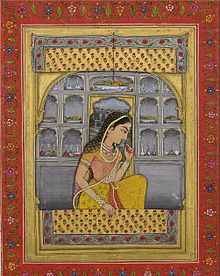
22Princess_Padmavati_ca._1765_Bibliothèque_nationale_de_France,_Paris.jpg

Alauddin Khilji, who died 701 years ago, was ruthless. He inaugurated his career by murdering his predecessor before proceeding to also murder very many Mongols when they decided to raid India. He then appointed himself chief raider, penetrated the south, scattered its kings, and couriered much treasure north. Under him, the sultanate towered over India and, naturally, he was eulogized by his own, despised by enemies, but inevitably commemorated in song and lore.

Last September, film-maker Sanjay Leela Bhansali received an atrociously worded letter for making a movie out of one such song, featuring the sultan with a fabled queen. “We have come to know through various reliable sources that you are portraying an imaginary character (sic)…of Rani Padmavati of Chittor who is a famous historical ICON (sic) of Rajputs’ age-old culture, valour & tradition…. Hence, we wish to make it very clear that your proposed film should be based purely on authentic historical facts and not in any allegorical manner. Hence, we forewarn you well in advance that there should be no deviation or distortion of History in projection of the iconic character of Rani Padmavati…”

Rumours circulated that Bhansali had sacrificed history at the altar of deviant distortion—in one “dream sequence”, he had the rani in an embrace with Alauddin, they said—and so a herd of self-appointed custodians of Rajput prestige descended on Bhansali’s set and demonstrated that courage and honour are counted today by the number of items smashed.

The “history” they sought to protect is a 1540 Avadhi work of fiction by Malik Muhammad Jayasi titled The Padmavat, which features a parrot that talks of a Sri Lankan princess’ beauty to the raja of Chittor. Dark-skinned Padmini (aka Padmavati) accepts Chittor’s proposal and becomes queen in the desert. A sorcerer, following in the footsteps of the parrot, sings praises of Padmini’s face in Delhi, prompting Alauddin to desire her. He besieges Chittor and, in a tedious compromise, the rani shows herself in a mirror to the sultan. In the end her husband is killed, and Chittor defeated. But instead of surrendering to the invader’s lust, Padmini jumps into a blaze.

“Awful sacrifice,” wrote James Tod (of The Annals And Antiquities of Rajasthan), followed “in that horrible rite of ‘jauhar’ where the females are immolated to preserve them from pollution or captivity…and the defenders of Chittor beheld…the queens, their own wives and daughters to the number of several thousands. The fair Padmini closed the throng and they were conveyed to the cavern…leaving them to find security from dishonour in the devouring fire…. The Tatar conqueror took possession of an inanimate capital, strewed with brave defenders, the smoke issuing from the recesses where lay consumed the once fair object of his desire.”

There is at least one instance of Alauddin seizing another’s wife (Kamala of Gujarat), but Jayasi’s literary cocktail, inspired two centuries after the siege of Chittor in 1303, had little to do with reality, notwithstanding all the nourishment the Rajput self-image has derived from it. Padmini became emblematic of (patriarchal) honour, Jayasi’s tale embellished numerous times over. Till the colonial age, these were romanticizations of Rajput valour in standing up to a mighty conqueror, and their preference for self-destruction over public ignominy.

The 19th century, however, saw Padmini upgraded from poetry to “fact”. Colonial writers manufactured the enduring impression of Indian history as a confrontation between Muslims and Hindus—which justified British rule to keep the peace in a land of competing antagonisms. The tale of Padmini was now a communal affair and a sample of Hindu suffering under Islamic tyranny, a perversion that has had enthusiastic takers in certain obvious quarters.

Even Indians who didn’t buy this invented historical conflict were willing to play up the “fact” of Padmini’s sacrifice to fuel the nationalist cause. As Sarojini Naidu said in an address to the Indian National Congress in 1917, “Womanhood of India stands by you today…as holders of your banner, sustainers of your strength. And if you die, remember that the spirit of Padmini of Chittor is enshrined with the manhood of India.” Padminifound herself a transfixed patriotic audience, and by the early 20th century versions were in circulation in influential Bengali circles also.

Historian Romila Thapar wrote, “An event occurs, and it slowly becomes encrusted with narratives about what happened.” The monumental irony with the Padmini episode is that narratives have been draped elaborately around a non-event drawn from the fertile mind of a Sufi. Meanwhile, Bhansali has ceased shooting in Jaipur, preferring to carry on in safer quarters where reinterpreting old poems does not invite hordes of self-righteous men who know little history but are determined to “punish” those who offend their over-sensitive sensibilities.

(My column in Mint Lounge, January 28 2017)

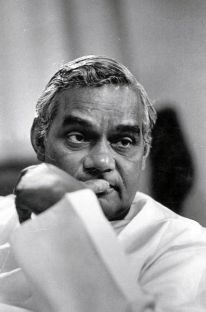
atal-bihari-vajpayee-15_122411083321.jpg

I spent Republic Day engrossed in a new biography of the man who extolled the virtues of the Constitution of our republic while also, as prime minister, submitting that “even in the mightiest fort one has to repair the parapet from time to time”. One cannot have an argument against reviewing constitutional provisions, if not its fundamental freedoms, periodically in a democratic system of our scale, size and diversity. But concerns that this proposal emerged from a protégé of M.S. Golwalkar’s (who famously lamented that our “cumbersome” Constitution was poorer for absorbing “absolutely nothing” from the Manusmriti) caused one former occupant of 7, Race Course Road (now Lok Kalyan Marg), to warn that this shouldn’t become a case of “tenants (going) for rebuilding in the name of repairs”.

Till the tenants lasted a full lease, there were few fears of this happening. I was six years old when Atal Bihari Vajpayee ruled India for 13 days, 8 when he returned for 13 months, and then from 1999 he remained Prime Minister till 2004. Among schoolboys of my time he inspired little heroic appeal, what with his vast person, capacious dhotis, artificial knees, and tendency to break into Hindi poetry about birds and peace. But our assorted fathers were quite charged by Vajpayee, who displayed might in nuclear avatar and prevailed over our ancestral enemy in Kargil. His everyday sobriety seemed to them an asset—and a relief—and there was genuine conviction that he would change India for the better. In many ways, he did. And thankfully this didn’t involve touching too many “parapets” of our constitutional fort.

Vajpayee, now laid up for years with age and illness, is a more interesting figure than he has been given credit for, and reading Ullekh N.P.’s The Untold Vajpayee, I was struck by how easy it was, in my youthful mind, to write off his grandfatherly style as uninspiring. This was a man who, in a party dedicated to the idea of the gau mata, had no qualms digesting a near cousin in the equation—Vajpayee loved buffalo meat. Bhang and alcohol were not taboo, but he was not a rebel-child, merely, instead, leading a life that embraced experience in all its variety. Endearingly, he welcomed his father’s desire to attend law school with him, the two Vajpayees sharing a hostel room, the son cooking his father’s vegetarian food. He never married, but for 50 years Mrs Kaul lived with him with her husband and children, and ran his household. When she died, Congress party chief Sonia Gandhi paid Vajpayee a condolence call.

In the Rashtriya Swayamsevak Sangh (RSS), this made Vajpayee an unusual figure, and more orthodox members lost no opportunity in maligning him for a lifestyle that was miles away from the pious guidelines the rest of them toed. As Ullekh writes, “Vajpayee alone could defy the RSS and get away with it.” One leading rival, Balraj Madhok (who charitably announced that “if Congress is malaria, Communists are the plague”), resented Vajpayee for a lifetime for his breezy successes in flouting dozens of rules while retaining full commitment from the RSS. Vajpayee’s ability to best better or at least more correct men with his charm, oratory, quiet shrewdness, and, most importantly his reputation for moderation, was hated by many but also became indispensable to the growth of the Bharatiya Jan Sangh and subsequently, the Bharatiya Janata Party (BJP).

Vajpayee was certainly diplomatic but he could also pose as a liberal when it was opportune to seem one, and act as quite something else when it wasn’t. Whether one defines this as political pragmatism or insincerity depends on one’s own principles, but since politics is an exacting beast, we can only pass judgement in a certain context. Certainly, the BJP wouldn’t have risen in quite the way it did without Vajpayee—if a hard-boiled RSS egg like Madhok had wrested control from Vajpayee in 1968, this faction would have remained true to their basic principles but never won the respectability and wide acceptance that Vajpayee’s method invited from people who would otherwise have found those basic principles abhorrent.

Vajpayee himself seems to have known this. In the mid-1990s, when he won an award in Parliament, he said: “I am aware of my limitations and I recognize my faults. The adjudicators must have ignored my limitations and mistakes to select me. This is a wonderful, unique nation. You can even worship a stone by putting vermillion on it.” He meant it in another context, but Vajpayee, when situations demanded it, wore the vermillion and said strange things, and when it suited him, posed as a less threatening stone.

This is perhaps why the opposition, while willing to parley with him, remained suspicious that Vajpayee’s poetry and moderation were a mask to further his own ambitions in an arrangement that also furthered an odious agenda shaped by other forces—forces he could not entirely control. Some years after the destruction in Babri, Ullekh points out, a video emerged that has Vajpayee, on the eve of the tragedy, joking that the “earth has to be levelled” for any ceremony to be performed. He may not have known what was about to happen, but he was quite willing to add fuel to the fire with which others lit a blaze. This was also the prime minister who described the demand for a temple as “an expression of national sentiment which is yet to be fulfilled”. The only defence here is that other prime ministers too have played with fire, and regretted it.

Vajpayee did, for most part however, play the statesman and earn respect, though his power was incomplete. More impatient, more aggressive elements in his own party worked to push him aside—it was almost as if having come to power on the back of his appeal, they felt it was now time for real business. The constitutional review and its 1,979-page report went nowhere, though—while his party rebutted the Congress’ criticism with a document titled Let Facts Speak For Themselves, pointing out that party’s attempts to “thoroughly re-examine” the Constitution years before, the din was too loud. And in 2004, the BJP lost power, and Vajpayee dissolved into retirement and illness. Today the BJP is under a different leadership—what plans, if any, are proposed for the Constitution need to be seen.

(My column in Mint Lounge, January 21 2017)

sabarimala-3.jpg

There is a goddess in Kerala who menstruates. The temple in Chengannur is officially dedicated to her consort, Mahadeva, but it is the bleeding image of the female deity that attracts masses of the faithful to the shrine. Every now and then a red spot “manifests” on the white cloth wrapped around the idol. The cloth is presented to females of an old Brahmin family who inspect it to verify whether or not the “blood” is divine discharge. If it is indeed what it is believed to be, fanfare commences—the deity is escorted to the riverside for a ritual wash before returning to her sanctum until the next spot necessitates her next bath.

Interestingly, the very Brahmin household that celebrates this menstruating goddess also supplies priests to another important temple in the state. But unlike the fecund goddess of Chengannur, the deity installed atop the Sabarimala hill is a bachelor who reportedly entertains reservations about receiving female worshippers if they happen to fall into the fertile age bracket. In other words, if you bleed, you cannot enjoy the privilege of an appointment with Ayyappan who, last weekend, watched over hundreds of thousands of pilgrims gathered for the annual makara vilakku festival.

The legends of Ayyappan of Sabarimala form a fascinating, eclectic tradition, involving a romance between Shiva and Vishnu (as Mohini), a Muslim associate who is commemorated in a nearby mosque, and an aspiring bride who awaits Ayyappan in her own temple. Then there is the “celestial flame”—the makara vilakku mentioned earlier—that appears every year in the far distance on a densely forested hill. The celestials lighting the fire turned out to be officials of the government, but the revelation hasn’t dulled Ayyappan’s massive appeal.

The custodians of his shrine, however, are determined about the rule concerning women. One particular woman called Trupti Desai is decidedly unwelcome. Some defend the custom by stressing Ayyappan’s bachelorhood—a weak argument since other Ayyappan shrines embrace all women, including those whose bodies perform certain periodic natural functions. Then there is the argument that it is not safe for women to go into the forest, which might have worked if we were still living in an age when roads and transport and the police were yet to be invented.

The principal argument, however, is that this particular Ayyappan does not receive women—each pratishtha or consecration of any deity has a sankalpa or founding belief specific to it, and for Sabarimala’s Ayyappan, unlike assorted Ayyappans in other districts, fertile women are taboo. Since keeping such women at bay is integral to the deity, it is the prerogative of his priests to uphold such integrity, they say. Priests can be forgiven for an exaggerated emphasis on tradition—that, after all, is their trade—but change in some form must prevail, if history is any lesson.

There were, after all, other temples in Kerala that prohibited certain groups. Kshatriyas were not permitted in Kumaranallur and Thrikkariyoor, while women (and for some reason, elephants) were barred from the temple in Thiruvalla—apparently one woman jumped into the garbha griha some time in prehistory and “merged” with the god. The priests banned women, possibly because they couldn’t brook such insolent short cuts to salvation. In 1968, however, astrologers decided that it was safe for the deity to be around women again and the ban was lifted. The case of the elephants is not known at this time. The case of Sabarimala, on the other hand, lies in the Supreme Court, where this conflict between something as amorphous as faith, and the law, which must be guided by reason to uphold fundamental rights, is being argued out. That will take its time but there have, interestingly, been comparable situations in the past where too custom was believed to be immutable, and any modern intervention deemed an improper assault on religious autonomy—but drastic intervention was made, and in hindsight has been accepted even by one-time detractors as essential.

In 1932, the maharaja of Travancore, alarmed by marginalized groups transferring their allegiance to non-Hindu religions, appointed a committee to consider granting them the dignity of access to temples. The committee’s report in 1934 was wishy-washy. “Exclusion from temples,” it claimed disingenuously, was “not always the result of the excluded class being considered inferior to others. It is based on a belief that the approach of certain people is likely to derogate from the spiritual atmosphere surrounding the pratishtha, the deity installed in the temple.”

In 1934, they meant low-castes in general entering all high-caste temples would have an impact on the founding principle of these temples; today in Sabarimala we believe that the approach of women will affect the religious foundations of that temple. “A large body of (high-caste folk) believe,” the report also added, “on the basis of the (scriptures), that the entry of the (low) into (their) temples would cause defilement of the temples…and there will be no efficacy in the worship or rites performed in them.” The report ended with a recommendation that the low should be provided “greater facilities” but care must also be taken that the orthodox were not hurt—the maharaja was to decide how far he wanted to go in making a concession.

As it happened, the maharaja went quite far. In 1936, he threw open public temples in Travancore (which covered parts of Tamil Nadu and all of southern Kerala) to Hindus of all castes, allowing the “low” to enter temples and pray before the gods. The Hindu religion did not crumble into defiled dust. Though its intention was to check conversions to rival faiths, the Temple Entry Proclamation was hailed as a historic reform, from Mahatma Gandhi to C. Rajagopalachari. Ambedkar, of course, could see that this had little to do with reform and more with political calculations, but that is another matter. At the end of the day, there is precedent for the executive intervening in religious affairs in Kerala and issuing reforms that the conservative priesthood would never have allowed. The big irony in Sabarimala with its priests is, of course, that they will accept a menstruating goddess but stand in the way of menstruating humans. Someone must show them the way.

(My column in Mint Lounge, January 14 2017)

img_0020.jpg

When Jyotirao Phule embarked with his partner, Savitribai, on their journey to promote radical reform, he had already smashed the social shackles that came with being the son of a greengrocer and the grandson of a gardener in orthodox Pune. This was a boy who received a rudimentary education in Marathi, found himself married before 13 to a bride of 8, and who then resumed his education in a Christian mission school at the insistence of a Muslim neighbour. While “correct” behaviour would have been to quietly keep stock of pulses and vegetables, he digested Thomas Paine’s The Age Of Reason and charted a course of his own, asking all those inconvenient questions that reason sparks in sensible people.

Jyotirao must have been an unusual man at the time for transmitting the ideas he absorbed to his wife. They were just on either side of 20 when they set up an institution for girls in 1848, dismissing conservative melodrama against female education as “idiotic beliefs”. That was revolutionary enough, but this thinker who drew inspiration from George Washington and dedicated his most important book—Gulamgiri (1873)—to “the good people of the United States” for eliminating slavery, then went on to establish a school for “untouchables”. This in a city where, till recently, the Peshwas had commanded the “lowborn” to move around with brooms tied to their waists so that the ritual defilement they brought into town could also be brushed away after every polluting step.

The Peshwas—hereditary ministers—had woven a great deal of princely myth around their high-born persons at the cost of their original middle-caste royal patrons, the descendants of the Maratha king Shivaji. Jyotirao dusted up in the dialect of the poor (which was thought crude) the tales of Shivaji’s valour, casting him as a protector of peasants and upholder of the rights of the weak. His irate respondents reacted with the more enduring construction of Shivaji as a protector of sacred cows. Jyotirao didn’t care. When the Brahmins claimed that they were high because they were born from Brahma’s mouth, Jyotirao asked if the creator also menstruated from that general area, before deploying Darwin to demolish his scandalized interlocutors. Because Jyotirao was a man, and a fairly influential man with access to the British, it was Savitribai who often faced physical retaliation for their work. This came in the form of being pelted with dung while she walked to their controversial schools, for example. She remained undaunted. In a village outside Pune, an untouchable girl got pregnant with her upper-caste lover. Lynching was proposed—the boy for disgracing his family’s honour and the girl for being disgrace itself—when Savitribai appeared. “I came to know about their murderous plan,” she wrote to her husband, “(and) rushed to the spot and scared (the mob) away, pointing out the grave consequences of killing the lovers under the British law.”

Naturally, many grumbled that with his tributes to the West, Jyotirao was an unpatriotic lackey. As it happened, he cheerfully exasperated the British too. In 1888 they extended to Jyotirao the honour of an invitation to dine with the Duke of Connaught. Jyotirao accepted, only to horrify his Victorian friends by arriving in peasant’s garb, with a torn shawl his chief accessory. He proceeded to lecture Queen Victoria’s grandson that he must not mistake his dinner companions as representative of India—it was the voiceless poor who were the soul of the land. On another occasion, when the Poona municipality sought to demonstrate loyalty to the governor of Bombay through a 1,000-rupee present, Jyotirao alone among 32 members opposed the idea, insisting that the money be spent on something more worthwhile than fanning the already inflated vanity of an Englishman: education.

He was upset with the colonial tendency to privilege Indian elites even in Western schooling. What “contribution”, he asked, “have these (elites) made to the great work of regenerating their fellowmen? How have they begun to act upon the masses? Have any of them formed classes at their own homes or elsewhere, for the instruction of their less fortunate or less wise countrymen? Or have they kept their knowledge to themselves, as a personal gift, not to be soiled by contact with the ignorant vulgar? Have they in any way shown themselves anxious to advance the general interests and repay the philanthropy with patriotism? Upon what grounds is it asserted that the best way to advance the moral and intellectual welfare of the people is to raise the standard of instruction among the higher classes? A glorious argument this for aristocracy, were it only tenable!”

When Jyotirao died, many thought the nuisance had finally withdrawn to the grave. Savitribai, however, continued to irritate the elders, breaching convention yet again by not only appearing at her dead husband’s cremation, but by also lighting the pyre. She died seven years later in the great plague of 1897, but many remembered her across western India and beyond on her birth anniversary last week through the rousing anthem she left: May all our sorrows and plight disappear/Let the Brahmin not come in our way/With this war cry, awaken!/Strive for education/Overthrow the slavery of tradition/Arise to get education.

(My column in Mint Lounge, January 06 2017)

macaulay-220.jpg

Shortly before the New Year, passed the death anniversary of Thomas Babington Macaulay (1800-59), the imperialist Indians of most political shades love to hate. Only infrequently is he remembered in the land of his birth, but in India, even the Internet generation has heard of Macaulay—once lampooned by the Tory press as a “shapeless little dumpling”—thanks to a quote widely ascribed to him. And like most controversies widely ascribed in the Internet age to historical figures, this one too is a fabrication, intended to outrage thin-skinned sensibilities while reinforcing right-wing resurrections of lost glories.

“I have travelled across the length and breadth of India,” Macaulay apparently declared, “and I have not seen one person who is a beggar, who is a thief, such wealth I have seen in this country, such high moral values, people of such caliber, that I do not think we would ever conquer this country unless we break the very backbone of this nation, which is her spiritual and cultural heritage, and therefore I propose that we replace her old and ancient education system, her culture, for if the Indians think that all that is foreign and English is good and greater than their own, they will lose their self esteem, their native culture, and they will become what we want them, a truly dominated nation.”

Like most humans, Macaulay was a man who said and did a number of contradictory things, some of which were wholly unpleasant in historical retrospect. And while he did institute a new (enduring) education system in India and introduce the language in which we transact national business—English—we can be sure that he would never have endorsed the backhanded compliments featuring in that spurious quote. On the contrary, he despised all things Indian and spent a career admonishing Orientalists enamoured of Sanskrit and other subcontinental charms for wasting their time on “a people who have much in common with children” (and therefore begged for imperial supervision).

Indian music, for instance, Macaulay dismissed as “deplorably bad”—the only unresolved question was whether it was vocal or instrumental music that was worse. All the Hindu gods were “hideous, and grotesque, and ignoble”—Ganapati was “a fat man with a paunch”. Even the better variety of Indian lacked sophistication—a glance at the furniture in the Mysore maharaja’s drawing room horrified Macaulay into comparing His Highness to “a rich, vulgar Cockney cheesemonger”. But most preposterous of all was his hatred of tropical fruits—the mango, for example, was as appetizing as “honey and turpentine”.

Macaulay was a creation of his times, both in terms of his racism and his conviction that Britain “ruled only to bless”. But before he became the scheming imperialist of Indian contestations, Macaulay was that young parliamentarian who campaigned for Jews to be able to sit in the House of Commons. He was that parvenu idealist who penetrated the aristocracy and fought to abolish slavery. Ruin, he warned, was the fate of those “who persist in a hopeless struggle against the spirit of the age”. And after he left India, he became a prolific writer, whose History Of Englandbecame a best-seller in America even as it upset Marx (who thought Macaulay a “systematic falsifier of history”) in England itself.

Macaulay came to India with prejudice in his mind, condescension in his pen—and because he was offered a salary 10 times what London provided, with many servants. He championed unpopular changes: The Indian Penal Code was the result of his labours, and remains the backbone of our legal system, despite its many unIndian provisions. The Indian Civil Service too, from which are descended today’s bureaucrats, was designed by Macaulay. But it was his Minute On Education (1835) that cast his name in stone.

Till Macaulay’s arrival, the East India Company supported what it deemed traditional Indian education in Sanskrit and Persian (i.e. education for an Indian elite, around whom other Indians had no chance). Activists in Bengal, including the likes of Rammohan Roy, were already clamouring for access to Western schooling, and Macaulay was a godsend. “Does it matter in what grammar a man talks nonsense?” he thundered. “With what purity of diction he tells us that the world is surrounded by a sea of butter?” It was not the business of government to watch students “waste their youth in learning how they are to purify themselves after touching an ass, or what text of the Vedas they are to repeat to expiate the crime of killing a goat”.

Instead, Macaulay decided, Indians must learn mathematics, geography, science—and they would learn it in English. Far from singing praises of Indian culture, he saw it as British destiny to bring modernity to India. “It may be,” he announced with patronizing sincerity, “that the public mind of India may expand under our system till it has outgrown that system; that by good government we may educate our subjects into a capacity for better government; that, having been instructed in European knowledge, they may, in some future age, demand European institutions.” And whenever that time came, “it will be the proudest day in English history”.

Macaulay succeeded in replacing Brahminical education with Western institutions, throwing open schools to all Indians. They could recite the Vedas at home, but at school, children would absorb the fruit of European modernity. Nativists resented Macaulay but there were others in India who embraced his presumptions—after all, a Jyotirao Phule, son of a gardener, could never have entered a Sanskrit school, but he was welcome in an English institution. He had no compunctions about being a Macaulayputra when the alternative was demeaning drudgery in the gardens of the upper caste, who only looked less haughty than Englishmen because they were brown.

India was merely one remunerative chapter in Macaulay’s life as a writer, parliamentarian, and public intellectual in England. And for all the debate his legacy provokes here among those who feel he manufactured a deracinated new elite, and those who owe their escape from the clutches of oppression to him, Macaulay himself would never concede he made a mistake. In the end, he died before his 60th birthday, very possibly sexually repressed, and concerned not about his disputed bequest to India but dreading impending separation from the person he most adored, his sister Hannah. She then came to Madras as the wife of another controversial English grandee. But that is another story.

(My column in Mint Lounge, December 31 2016)

Sometime ago I went to watch an atrocious Hindi movie called Mirzya, perhaps the worst specimen Bollywood produced in the last 12 months when it wasn’t being dragooned into seeking the “blessings” of local brutes for undisturbed releases. It took a while, though, for the audience to accept that the film was unfolding disaster, mainly because, at first glance, it was breathtaking. Each frame was visual delight, much like viewing exquisite landscapes through amplified Instagram filters. Halfway in, however, it became clear that despite the splendid settings, all hopes of a story emerging were futile, for the whole project dozed lazily on the back of its impressive cinematography. And on the charms of its actors pouting and posing in appealing fashions. When the movie began, the cinema hall was plump with hope; by the middle, it was clear that the ordeal was winding towards an eminently deserved flop.

Looking back at 2016, the tale of the government of India follows a corresponding line—much posing and grandstanding, but lacking that small thing we call a plot. Given this regime’s predictable propensities, the first defence tossed up is that if a plot is nowhere to be found, the blame lies with the depredations of the Congress for 60 years. And after much mournful head-shaking about the sins of a wicked dynasty, we are pointed towards the latest good intentions announced by our noble Prime Minister, who also wins in the department of being able to conjure up diverse emotions in stunning succession—defiant laughter when demonetization was received with obvious alarm, for example, and tears when this “surgical strike on black money” commenced its own inevitable spiral towards a tragic flop.

Demonetisation was probably expected to provide one of those mythical “big bang reforms” to the Bharatiya Janata Party’s clamouring constituencies, crowning also the government’s high-decibel, minimum-result quest against illicit wealth. Given the vacuum that is the intellectual reserve of the ultra-right in India, it is a given that the “next big idea” will not soar majestically out of their stables. But with all the overworked economic jargon in recent years, one would have expected at least one or two fully-baked financial proposals. Instead, what we have as 2016 inches to a shaky conclusion is a farce. And the government knows this—what was ostensibly a “war on black money” has been hastily reassembled as a vision to “make India digital”. After all what is the point of having a face if one can’t save it.

The authorities remain undefeated in inventing slogans too, but I wonder if Modi’s endeavour is to retire in history as the BJP’s reaction to Jawaharlal Nehru (with the enthusiastic, even if confused, emphasis on foreign policy) or Indira Gandhi (with all the centralization of power). Or perhaps it is P.V. Narasimha Rao he seeks to emulate, though if 8 November is any evidence, he isn’t going down as an economic mastermind after wiping out 86% of the national cash and forgetting about the little matter of replacing it. The best that can be done this New Year’s eve, given the circumstances, is to grin and bear it and join the government in twiddling our thumbs, chanting the word “progress” in the hope that progress actually makes up its mind to follow.

The irony is that in 2014 Modi took power promising Indians the moon that the Congress unjustly eclipsed for six decades. Nobody, though, warned us that after 10 quiet years with Manmohan Singh we would have a leader anxious to speak on radio, on TV, at live concerts, through mobile phone apps, and on other assorted forums except, of course, in Parliament. There he prefers to rest his voice—a clever strategy that once again this year exposed a fragmented opposition while Modi cornered stoic dignity for the cameras. In the meantime, we aren’t anywhere closer to the moon. And while the government lobbies obstinate ratings agencies to grant its lethargic performance a higher grade, there are methods to erase from public discourse all talk of the sputtering India story by replacing past promises with 24×7 distractions.

For instance, the aggressive tests of who is and isn’t with “the nation”—the latter were informed through the usual TV channels that they might find Pakistan more hospitable and should consider emigration. University students found themselves at the receiving end of new lessons in character building—it was the old way to believe that academic spaces were open to debate and dissent, where outrageous ideas are defeated by better thinking. Tall flags are being installed on campuses to impart to students the significance of loyalty to tangible establishments like the state, as opposed to refractory illusions of free thought. Free expression didn’t take Rohith Vemula far, after all, and Najeeb Ahmed is still missing—better to become uncomplaining bricklayers for “the nation” envisioned by the “pradhan sewak”.

This preference for compliance, which was pushed a little more this year and will continue making inroads in the next (through the systematic crippling, for example, of NGOs), comes, like all things in the BJP, from tradition. This was highlighted by the estimable M.S. Golwalkar, second “supreme leader” of the Rashtriya Swayamsevak Sangh, who wrote at length on how democracy is actually a dreadful, horrid idea. It would, he believed, “poison the peace and tranquillity of the human mind” and “disrupt the mutual harmony of individuals in society”. Leaders must be worshipped and supported, not questioned. Golwalkar, in fact, celebrated monarchy as “a highly beneficial institution…showering peace and prosperity on the whole of our people”.

We can look forward in 2017 to more “tranquillity” and “mutual harmony” in the way of monarchs, and as with that awful movie mentioned earlier, the Prime Minister will be there to strike poses and give us sentimental speeches while his cheerleaders desperately scout for that elusive thing: an actual plot.

(My column in Mint Lounge, December 24 2016)

periyar.jpg

“There is no god. There is no god at all. He who created god is a fool. He who propagates god is a scoundrel. He who worships god is a barbarian.” I was reminded of this refreshingly blunt mantra of Periyar’s last weekend at a discussion on “contrarian views” at the Bangalore Literature Festival, not because the idea of god was under investigation, but because we live in times when scrutiny of even powerful mortals is deemed “contrarian” when really it is just an application of common sense. As an apoplectic member of the audience told one of the panellists off for daring to present a dissenting opinion “while soldiers are dying on the border” etc., I wondered what Periyar, born E.V. Ramasamy Naicker in 1879, would have said if someone asked him to swallow his voice because it was the fashion of the day to obey like good children and to think inside the box.

Today is the anniversary of Periyar’s death in 1973, and one can’t help but imagine him leading the ranks of raging “anti-nationals”. He had come close enough already in the age of the Mahatma, against whom he maintained a catalogue of disagreements, declaring that Independence Day was really “a day of mourning”. On another occasion, he thought the Constitution deserved all the honour that came from being burnt.

Anti-national was not the favourite term for those who refused to follow the herd in Periyar’s time, but he was something perhaps even more unusual: He was the anti-Gandhi. Those who were privileged could stomach Gandhi, while Periyar gave them a severe case of indigestion. And yet many Indians of his day embraced him and millions celebrated his rationality instead of falling in line with what venerable elders chastely decided was “proper”.

Where Gandhi was the embodiment of saintly piety, Periyar exemplified rebellion. Where Gandhi romanticized rural contentment, Periyar envisioned an ambitious age of aircrafts and heavy machinery. While Gandhi renounced sex in his 30s, Periyar married a 30-year-old in his 70s. When Gandhi’s satyagrahis in white stood up to British tyrants, Periyar excoriated the very Indian tyranny of caste by leading his Self-Respect Movement in black. Where the Mahatma’s nationalism was immersed in Hindu morality, Periyar was an atheist who wrote op-eds titled “Honeymoon In The Hindu Zoo”. Gandhi spent a lifetime seeking to tame the flesh while Periyar flaunted it (and had himself photographed) among like-minded nudists abroad. And where Gandhi was cremated like a good Hindu, Periyar was buried, flouting every dictum issued by his forefathers, who were not beyond reproach.

Gandhi celebrated Sita as the embodiment of Indian womanhood with all her purity and self-sacrifice, while Periyar declared the Ramayan to be full of “absurdities”, with quite a different sequence of superlatives for its heroine. Gandhi painted visions of ideal women, while Periyar warned ordinary women to beware of deification. “Have cats ever freed rats? Have foxes ever liberated goats or chickens?” he asked. “Have whites ever enriched Indians? Have Brahmins ever given non-Brahmins justice? We can be confident that women will never be emancipated by men.” Gandhi thought motherhood was divine and spiritual; Periyar saw pregnancy and childbirth as “impediments to liberty and independence”, promoting birth control even if it came at the expense of womanly salvation. Against Gandhi’s sage-like pronouncements, Periyar was branded immoral. “Morality,” he wryly remarked, “cannot be one-way traffic.”

So too with nationalism—now available in your nearest movie theatre—was Periyar irreverent. He viewed it as finely woven, brilliantly designed deception, diverting masses of people from the real state of affairs, sometimes through emotional blackmail and sometimes through the intoxications of pride, and keeping them from checking the book of democratic accounts. He was suspicious of saints, arguing that Gandhi, with his “religious guise, god-related discourse, constant mention of truth, non-violence, satyagraha, purifying of the heart, the power of the spirit, sacrifice and penance on the one hand, and the propaganda of his followers…who in the name of politics and the nation consider him to be a rishi, a sage, Christ, the Prophet, a Mahatma…and an avatar of Vishnu”, had become “a political dictator”.

Gandhi, to him, sought freedom from the British but feared social upheaval at home even if it offered greater justice—he preferred order over equality. “A bhangi does for society what a mother does for a baby,” claimed Gandhi patronizingly, seeking “the beauty of compromise” in social dynamics between the low, who had answers to seek, and the high, who had much to lose. Periyar ached for radical action, once recommending that “if you have to choose between killing a Brahmin or a snake, spare the snake”. Gandhi thought “life without religion is a life without principle” and that education must never lose sight of its moral responsibilities. Periyar believed that the “worship of god, practice of religion, propitiation of rulers, which are all calculated to keep men in mental slavery, should never (even) enter the portals of education”.

Periyar was the enfant terrible of his time, puncturing with unafraid focus holy narratives of India’s destiny at a time when the Mahatma was convinced of this destiny. He was a contrarian, and was branded worse, but Indians of his time absorbed his thought just as they embraced Gandhi’s vision. He was handicapped, perhaps, by language and, besides, political incorrectness hardly makes for a great career. But sitting in Bengaluru listening to even the most elementary expressions of common sense provoke admonishments, I wished we had a Periyar here again, not to set the cat among the mice but to hold up a mirror and to remind us that there is always another way, and that we must sometimes stop following and start thinking.

(My column in Mint Lounge, December 17 2016)

8a07970abef5b00d3d3c83136dc72c80--tamil-actress-displays.jpg

I was 11 years old when, in accordance with astrological counsel, chief minister Jayalalitha of Tamil Nadu became chief minister Jayalalithaa in that very land where Periyar once acidly denounced peddlers of such counsel as “arch exploiters” and “parasites”. Of course, changing one’s name can be defended as an entirely private concern, and in any case Jayalalithaa really entered my personal universe not on account of her reported enthusiasm for numerology, but when, that same year in 2001, she imprisoned the antagonist of her political universe, M. Karunanidhi, in one of the more infamous episodes in their long-running vendetta.

It was my then best friend Venkatesh R. who transported the news from his Tamil household in a mood of great agitation, which was difficult to take seriously from a classmate who otherwise only demonstrated such feelings when dealing with fractions and the decimal system. I carried my observations on his odd behaviour to my not-too-politically-inclined mother, who informed me that the lady in question owned 750 pairs of shoes (one wonders if her long-time aide and that one-time video-renting entrepreneur Sasikala will fill all the shoes in question if she does succeed in gripping the AIADMK party by the horns.)

I was older by the time I discovered that Jayalalithaa was more than the sum of her shoes and numerological beliefs, and that this pale woman of ample proportions who animated an entire state and its people for decades had, like all human beings, layers to her personality—leaving out the rumoured bullet-proof vest—and facets that were fascinating, inspiring, frequently disturbing, but marked with that complicated quality known as determination. Of course, given that even the world’s great villains have volumes of determination, this is no exoneration of the imperiousness, that tendency to bully the press, and those instances of blinding ostentation that deserved the electoral disasters they showered upon Jayalalithaa on more than one occasion.

She was a film star once, I learnt, who ran around trees and batted her eyelashes while actors lifetimes older lip-synced songs about the ecstasy of youth. She wasn’t naturally inclined towards such graceful prancing, having shown early on as a child an inclination towards a more studious professional future. But compulsions facing her mother and the need for money meant that plans for university were discarded and the trees and colourful sets of Tamil cinema became the backdrop for the early period of her career. She became a (heavily made-up) star on screen, translating thereafter, like her predecessor at the helm of the party, MGR, the hero worship this inspires into astonishing political success (minus the make-up).

She had to win battles, like everyone in public life, but as a woman in a world structured for men, her battles were doubly challenging. She didn’t emerge kinder for the experience, though, welding armour instead around her battle-scarred person, and behaving largely like those very men who resented her. She manifested arrogance, about which one could be sympathetic by viewing it as a reaction to the trauma she faced in the defining years of her political career. But she wasn’t the type who sought sympathy either, seeking to be worshipped but also feared, more an empress than an accountable democrat. She cared for her people, but as a grand matriarch would for subjects and not as an elected official with a time-bound mandate.

That Jayalalithaa had tremendous intelligence and ruled well—and I don’t think populism is an entirely misguided concept—in great measure is certain. That, however, she demanded unquestioning obedience suggests that instead of creating institutions, she installed herself as the premier institution in sight. Many who venture political opinions called her a venal tyrant, rejecting her narrative of the lone warrior prevailing against odds that appeared in male (and legal) avatars. Middle-class frustration was vocal as she cornered the limelight that power invites, but only made choreographed appearances under it. She revelled in her status as puratchi thalaivi (revolutionary leader), and tolerated nothing that challenged her role as the goddess of millions who made good policy while also dispensing reliable mixer-grinders.

Strong women are good for societies such as ours which still privilege a very male vocabulary of power. And I grew to admire Jayalalithaa and the personal story, with all those ingredients of grit and resolve, of the woman who rose to these heights, inspiring others to also fight their battles undaunted. But it is Jayalalithaa’s political legacy that must now stand scrutiny. For she did much good as an administrator but could not rise beyond herself and create something that could outlive her—she was a phenomenon and with her passing dies also the ideology that energized her followers for years: an ideology contained within the numerologically sound 12 alphabets that constituted her name.

Much has been written of men who rotated at Jayalalithaa’s feet, but not enough has been said about how few were the women she brought into positions of power. She carved out for herself an indelible niche, but didn’t create an enduring space so that others could reach where she did, less bitterly and with fewer battles on the way. If a woman does find her way to a niche somewhere close in terms of power even if not immediate appeal, that would be through the transformation of chinamma Sasikala into general secretary Sasikala of the AIADMK, a production currently underway, the prospects of which we must wait to watch.

(My column in Mint Lounge, December 10 2016)

1578bf14c7cde2e4510b5f3170f2b646--self-portraits-pakistani.jpg

Amrita Sher-Gil was not a likeable person, furnishing sharp opinions at a time when women in respectable society produced only sweet expressions and blinked. But then, she never aspired to join the ranks of respectable women, moulded instead by her own heady individuality. She could be vain (“Europe belongs to Picasso, Matisse, Braque and many others. India belongs only to me,” she once declared), just as she could be horribly rude (“What an ugly little boy!” she said of Khushwant Singh’s toddler). And, as Malcolm Muggeridge, her one-time lover remembered, she was also rather “self-consciously arty”, demanding recognition on precisely the terms she defined, damaging her own cause with unrestrained impetuosity.

Sher-Gil was the firstborn of a Sikh nobleman prone to melancholy ruminations, whose other claim to fame was that Princess Bamba Duleep Singh had once pursued him. He fortified himself against her royal charms and married instead her companion, a Hungarian whose music career was distinguished largely by its absence, before she went on to shoot herself. Sher-Gil was raised by her very clever and depressed parents in Hungary, where they were stranded during the Great War, and then in India, where schooling at a convent was terminated after she pooh-poohed Catholic rituals. There was also a stint in Florence while her mother attended to a romance, but it was in Paris in the late 1920s that the painter the world remembers flourished.

“Towards the end of 1933,” she wrote, “I began to be haunted by an intense longing to return to India, feeling in some strange inexplicable way that there lay my destiny as a painter.” And return she did, at first producing works with names like Mother India and The Beggars, partially succumbing to that magnified sentimentalism found today in the NRI brand of nostalgia. But she evolved quickly a singular style that stood aside from all prevailing “schools” of art. She frowned upon the condition of modernism in Indian painting: Raja Ravi Varma’s works in oil were an Indianization of colonial styles, and the Bengal School had, in its anti-colonialism, itself lapsed into an establishment with all the attendant inflexibilities.

Sher-Gil set out by herself, with a conviction that she would succeed in improving this “provincial artistic milieu” where others had failed. She created art for art’s sake and not to entertain or flatter constituencies. She was unsubtle in her personal conduct and missed diplomacy—not essential for the exercise of artistic ability but indispensable for sales—by miles. In Hyderabad, for instance, she told off one of its biggest art collectors for his bad taste which made her “sick”. The nawab in turn asked her to peddle her “Cubist pictures” elsewhere. Naturally, in her lifetime, Sher-Gil saw only modest commercial success, often descending into frustration about where she was headed.

Where she was headed was in the direction of untimely death (the result of the final of the several abortions she had in her 28 years). But in the interim, Sher-Gil produced some remarkable works, discovering forgotten artistic brilliance in her Indian roots while eschewing mindless romanticism. When she saw erotic frescoes in Fort Kochi, featuring “great fat women in the act of giving birth” she was struck by their “utmost candour”, commenting that she had “seldom seen such powerful drawing”. After viewing paintings at Ajanta, millennia old, she declared that a single fresco there was “worth more than the whole Renaissance”.

These were not the words of a nationalist invigorated by ancient glories—she spoke in terms of the art alone, which she found startlingly original and full of vitality, unlike copycat painting that made for a supply of pretty pictures and many pretensions.

After she died in Lahore in 1941, Sher-Gil acquired a cult following. Her dalliances with women, mixed parentage, unwanted pregnancies—including, one from a wealthy suitor her mother identified and another from a Reutersjournalist on the eve of her wedding—not to speak of her tremendous personality, all carved out for her a unique, fascinating niche. Her art was unprecedented in style and substance, but the artist too was unforgettable. She was aware of this self-image and the effect she had on people, though personally she thought she was “like an apple, all red from outside but rotten inside”.

Most importantly, perhaps, she once declared that the “artist has every right to reject or accept public estimates of her work. When the public makes a mistake regarding a picture, it is the business of the artist by some gesture to show that the public is un-informed and dull.” Only she could have said it. In other words, she would not play to the gallery, because she was convinced that the gallery must see the wisdom of her more sophisticated view since that is what was correct.

Last weekend was the anniversary of Sher-Gil’s death and I was reminded of her in the context of something Carnatic musician T.M. Krishna—a rebel of sorts in his own field—said in a lecture some weeks before in Thiruvananthapuram. Referring to political contestations in the cultural space, he informed his audience that the role of the artist is to make interventions when the public acquiesces in a state of affairs that is less than ideal and to stand up to the pressures of the herd. Sher-Gil was not concerned with issues of public interest, but her commitment to art as something intrinsically superior to popular forces is well worth remembering today, 75 years after her death.

(My column in Mint Lounge, December 03 2016)

Section-377-of-IPC.jpg

As Delhi celebrated Pride last weekend, I was reminded of Siddharth Dube’s memoir, No One Else, which recounts the stigma suffered by his generation of men who were born homosexual. Dube grew up in affluence in the 1970s, studied at the Doon School, and went to university abroad. But the defining attribute of his existence, particularly as he worked in public health and confronted prejudice and ignorance on sexual issues that has had catastrophic policy implications, is one that cuts across class. Section 377 means he, like “disgraced” Aligarh professor Ramchandra Siras or the latter’s rickshaw-puller lover, is a second-class citizen in our country. The accident of birth into the upper class allowed Dube insulation; Siras, in his mid-60s, died tragically after strangers breached the privacy of his bedroom and filmed him with his lover in 2010. The rickshaw-puller too made an attempt to kill himself, but had to go back to pulling rickshaws because his children needed to eat.

Section 377 is not so much about intercourse as much as permitting instruments of the state a handle to persecute a section of its citizens. Blackmail, extortion, and intimidation by the police as well as by outsiders, who threaten to turn in flouters of this archaic law, are the sum of what Section 377 has achieved ever since the Victorians inflicted it upon our ancestors in 1860 in their quest to “civilize” us. Same-sex love, which was perfectly acceptable in Hindu society in previous times, was slapped in our face as yet another confirmation of our backwardness, justifying the need for imperial intervention in India. Our elite, embarrassed by the West, embraced their regressions, and let it stay on our law books after 1947. Meanwhile, back in Britain where these ideas were originally designed, they were thrown into the dustbin—without a colonized people to “civilize”, such tools of oppression served no purpose.

It is natural, then, that the generations that have followed Dube’s are today, in 2016, growing more and more impatient with this colonial travesty that masquerades as considered legislation. The reversal of that historic 2009 Delhi high court judgement, which struck down Section 377 as unconstitutional, by the Supreme Court four years later was a setback of calamitous proportions. The court reasoned that Section 377 was rarely exercised (with only 200 cases brought before it in all the history of the law), and that in any case all this concerns only a “minuscule fraction” of our population. The judges added that “those who indulge in carnal intercourse in the ordinary course and those who indulge in carnal intercourse against the order of nature constitute different classes; and the people falling in the latter category cannot claim that Section 377 suffers from the vice of arbitrariness and irrational classification.”

Leila Seth, the mother of a distinguished gay son, remarked that the argument that “justice based on fundamental rights can only be granted if a large number of people are affected is constitutionally immoral and inhumane”. The judges however transferred the onus of resolving this conundrum to Parliament. The Congress party has publicly declared support for decriminalization, but has not followed up vociferously enough—Shashi Tharoor was thwarted twice when attempting to introduce a Bill against 377 in Parliament, but his party benches were largely empty (disclaimer: I work for Tharoor). The Bharatiya Janata Party’s (BJP’s) Rajnath Singh, on the other hand, at once welcomed the Supreme Court strike-down, since to him homosexuality is an “unnatural act”. Finance minister Arun Jaitley has expressed views in favour of decriminalization. The essence is, however, that political consensus will take more time to construct. Moreover, since the “minuscule fraction” is not a political constituency, there is no electoral advantage in investing in their fundamental rights. Add to this that the current government is massively indebted to conservative factions, and a near-term resolution seems more and more distant.

That said, the fact is that the march of time means Indian courts and the state will inevitably have to face reality and those ideals we call justice and equality. Dube’s generation fought its battles at a time when they had few resources and practically no information about wider struggles around the world. Today men and women are less inhibited and more empowered in the Internet age, and the fight for fundamental freedoms will continue. As for claims that homosexuality is against Indian culture, there is plenty to show that this was hardly the case, besides which the Internet has allowed for the successful pursuit of same-sex relationships without the nose of the state getting in the way. Of course the irony is that while the BJP has taken a position against permitting gay citizens the right to live their lives in all its natural fullness, during the 2014 election, ads soliciting votes for Narendra Modi appeared on the gay dating app, Grindr.

The party was evidently embarrassed. The lesson, though, is that while such embarrassments are momentary, one day, when justice has prevailed, many will be left struggling to reconcile their past objections with what is right, and to answer for defending antiquated fallacies. Upholding an oppressive tool of colonial vintage against sections of society who have a right to lead complete lives without fear of persecution and stigma is what the debate on Section 377 boils down to; and to all who can see the bigger picture, the side they must pick should be clear.

(My column in Mint Lounge, November 26 2016)

narendra-modii.jpg

When patricians of the Congress party installed Indira Gandhi as their preferred gungi gudiya(dumb doll) in 1966, she wasn’t supposed to have a spine or a mind. She horrified them by wielding both, and soon the elders disappeared into historical cold storage while Mrs Gandhi transformed into what is called a “towering leader” and a memorable prime minister whose birth centenary year celebrations commenced last week. Facing an erosion of support for the Congress, her politics in the late 1960s tilted left, and after she prevailed over Pakistan in 1971 (and stood up to White House bullies) emerged her famous slogan of garibi hatao (banish poverty) when someone proposed that it was time to banish Indira.

Leaders in democracies, however, must simultaneously sustain power and stay in charge of the public narrative, all the while maintaining stability and the capacity to deliver. Mrs Gandhi’s socialism was embraced by a deeply impoverished electorate, but soon after her triumph in 1971 (on a “wave” that surpassed Narendra Modi’s in 2014), narrative alone ceased to be adequate. Poverty refused to depart, and crises piled up, from labour unrest and railway strikes to student agitation followed by Jayaprakash Narayan’s movement. Oil prices multiplied, and aid from the US was suspended. A cornered Mrs Gandhi imposed the Emergency, but returning to power in 1980, she quietly discarded socialism and began to reinvent herself, favouring new solutions to old problems.

But the point here is that narratives can purchase time for governments ruling in challenging circumstances and persuade the electorate to remain patient with the system and its plodding. And the most effective narratives are not always those that are logical but which have ingredients that appeal. Economic trouble, for instance, had already begun in the 1960s but garibi hatao was a compelling promise and the Congress was given a powerful mandate. Expectations were not fully met—and the opposition got its turn in power, therefore—but there were dramatic segments that bolstered the government and prolonged its rule. Mrs Gandhi’s determination in abolishing the privy purses granted to India’s former princes is one example of this.

At the time of independence, this order controlled a third of the subcontinent and one in five Indians was a subject not of the Central government, but of a princely specimen. In return for relinquishing territory in what Sardar Vallabhbhai Patel called “a bloodless revolution”, assorted rajas and nawabs were given the carrot of allowances and certain vanities, politely called “marks of prestige”. The princes were often vulgarly feudal, but the amounts disbursed to them, while generous, were not handicapping the economy. However, in keeping with the plot of garibi hatao and the “egalitarian social order” it envisioned (and because many princes challenged the Congress), Mrs Gandhi toppled these ex-rulers.

It was a hugely popular move, and it satisfied public appetite for “visible action”. The people who lost were a privileged minority (though there are still Indians who receive government allowances as royalty—the nawab of Arcot appears on the Warrant of Precedence with the perks of a cabinet minister). And “the masses”, watching princely pretensions cut to size, endorsed the prime minister and gave her their patience, even if beyond the consolations of narrative, this did not particularly empower them.

I was reminded of this when Prime Minister Modi made his dramatic announcement demonetizing high-denomination currency notes to vanquish the hydra that is black money. As a candidate for election in 2014, he had promised an electorate (convinced that everyone in the previous government was sleeping on mattresses of notes) Rs15 lakh each of the illicit cash he recovered. As prime minister, rhetoric has obviously not evolved into action. Something else that is “visible” and dramatic could shore up support in the face of impatience, even if it makes no difference to the problem itself—a Mumbai jeweller described to me how many in that business are back-dating bills to cater to cash-rich customers streaming in since 8 November.

Whether this is about herding people from a massively cash-driven economy into formal banking and executing a structural reform is not clear. The government should have been better prepared if this were a grand “plan”, though this would hardly be the first time a major exercise began and ended in chaos in this country. For now, though, despite queues, alleged deaths, and confusion, large numbers of people seem willing to tolerate the situation. The sheer audacity of the move has suggested that perhaps the Prime Minister knows what he is doing. Either way, for Modi, who rose to power with the 21st century “aspirational” equivalent of what garibi hatao proposed in 1971, this could buy time.

The difference, however, is that while abolishing privy purses was also dramatic in effect and in terms of the political dividends it yielded, its casualties were an obscenely wealthy minority, in whose decline the voter saw justice. Today it is not Bollywood-style villains with suitcases of cash who face the repercussions of demonetization but also rural men and women and the urban poor who are suddenly cast adrift. And when they find out that actual villains have real estate and gold and other parking spots for black money and that none of them sweat in queues, as the Prime Minister claims, they might be somewhat less supportive of being taken for a ride. One hopes Prime Minister Modi does have a plan.

(My column in Mint Lounge, November 19 2016)

2016_7$largeimg104_Jul_2016_003412030gallery.jpg

The victory last week of Donald Trump in America petrified masses of people who happen to not be men or white or Christian or straight in that country. But it also petrified this columnist, who suddenly felt immense amounts of pressure to reflect on the decline of The World As We Know It and the rise of a wild strongman to the throne in Washington. Then, however, comments emerged from a strongwoman (of the subcontinental variety) on another matter altogether, and suddenly my column was saved. With much relief, I cast aside Trump and the prospect of contributing a furious denunciation and chewed with gratitude on column fodder supplied, instead, by a distant associate of his in the universe of the political right.

“There is nothing called marital rape,” was the opening insight supplied by the general secretary of the Rashtra Sevika Samiti (a women’s body, which, like its guiding organization, becomes “RSS” in acronym). No marks for originality to the general secretary, though—after all, she and I live in a country where successive governments have defended this line of policy with nervous pronouncements about “Indian culture” and “the institution of marriage”, both of which are apparently so fragile that an acknowledgment of violence would invite catastrophe. There is nothing called marital rape in our law books, and to that extent the general secretary is not wrong. But law books can, she should know, reside in the Stone Age—I happen to be named after a character who supposedly authored, in 2,684 verses, one such prototype called the Manusmriti. Fortunately, it was so bad that most people had the good sense to ignore it.

“Marriage is a sacred bond,” came next in the RSS secretary’s comments, which my venerable ancestors in Kerala would have dismissed—no offence—as balderdash. They were matrilineal Nairs, among whom it was the bond between brother and sister that was sacred; husbands and wives were dispensable. My great-great-grandmother’s first husband was not up to the mark and was dismissed, despite his many tears, from her presence in 1883. She then married my great-great-grandfather, who in turn had dissolved one previous marriage. They then went on to produce a man who successively espoused three women in the 1910s, before confirming the fourth. All of these people were pious, orthodox, “good” Hindus, but in their cultural context, marriage was most definitely not “sacred”. It was an arrangement, which could last a lifetime in cases, but was by no means binding on either party.

All that was needed for the wedding ceremony was an oil-lamp and the exchange of a piece of white cloth. If the lady accepted, the sambandham(relationship) had commenced. Indeed, so effortless was the process that when a governor of Madras in the 19th century, after a conversation on textiles with a Nair lady, offered to “send her a cloth” as “a specimen of the handiwork executed there”, the woman coyly replied that while she was “much obliged”, she was “quite satisfied with her present husband”. And all that was needed for divorce was for the cloth in question to be torn (or if one wanted to be direct, for the husband’s things to be left by the door—Malayalees were thrifty with time).

It was morality imported by Bible-wielding missionaries that converted marriage into a “sacred” affair, encouraging Nair women to forfeit sexual independence in return for patriarchal conformity as “good” wives. “Women, instead of fighting for rights, should focus on their duties, on how they can hold the society together, impart patriotism to their children and family members,” the RSS general secretary had declared in August. Apart from an unnecessary “the”, this line would comfortably gel into the propaganda unleashed in Kerala in the late 19th and early 20th centuries to persuade women to accept marriage as “sacred”, by men who reacted to Western criticism of their customs by ingesting that criticism.

I must confess I am not optimistic that this lesson in history will persuade the general secretary to change her mind because according to her, “social evils in our society are due to (foreign) invasion of 1,000 years. It will take time for society to come out of it.” In other words, if strange customs existed to demonstrate that a number of Indians did not treat marriage as sacred, they must have been perverted by influences from elsewhere (and I am tempted here to tell her the tale of the Kerala princesses who surprised an Italian in the early 17th century by showing up topless at court—he wondered why these women had such an abbreviated sense of dress, and they were puzzled, in return, by the layers of fabric with which he was encumbered—but I shall leave this story for another occasion).

Now, we turn to the final segment of the general secretary’s remarks: “Coexistence should lead to bliss. If we are able to understand the concept of this bliss, then everything runs smooth.” With this I have no disagreement, absolutely, for who does not want things to run smooth. In fact, it is my sincere hope that the good lady will forward this sentiment to president-elect Trump, who most certainly would benefit from lessons in the bliss of coexistence now that he can stick his thumb on nuclear buttons. Some good, then, may come out of the sum of her otherwise unevolved statements on marriage and marital rape.

(My column in Mint Lounge, November 12 2016)

mao_zedong_portrait.jpg

I must admit I feel a mischievous delight in being able to compare our “hon’ble minister” for information and broadcasting, Venkaiah Naidu, in his spotless white shirt and mundu, to Chairman Mao of China, who must have been somewhat less spotless after not bothering to shower for 27 years (he preferred sponge-baths). But it is not lightly that I make this observation, for the substance of the pious wisdom that has emerged from the minister in recent times is to me, as a historian, reminiscent of a number of ominous statements an unwashed Mao made some years before his rise to titanic tyranny in China—a China where people were buried alive so Mao could prevail.

It is not my intention to suggest that Naidu has anything else in common with a bona-fide dictator like Mao—his duties in information and broadcasting can hardly be compared to the terror of a man whose regime invented hundreds of ways of torture, with names like “sitting in a pleasure chair” and “monkeys holding a rope”. However, the similarity of tone in a number of recent utterances is difficult to miss, and favours intellectual positions that empower illiberalism and the centralization of power at the cost of freedom. Take, for instance, Mao’s “ideals are important, but reality is even more important”. To this, Naidu’s own “art has no boundaries, but countries (do) have boundaries” sounds like an affirmation that the mind must work within frontiers. And gatekeepers of these frontiers become the policemen of thought.

But this too is not a particularly original line of regressive thinking—any urban, middle-aged, middle- class, upper-caste male “outraged” by the “appeasement” of minorities, by reservations for “lazy” Dalits, by “sickulars” on Twitter, and by women in trousers could arguably have said all this without being suspected of wanting to follow in Mao’s bloody footsteps. So what really lends itself to comparison (after this lengthy preamble to try and ensure I am not sued) are the remarks our minister reportedly made about his view of an ideal press environment in India—that is, ideal for rulers and quite the opposite for those of us at the other end of the arrangement—and certain infamous, corresponding declarations Mao issued in 1942 at Yan’an, setting terms for freedom in the China he went on to scar forever.

Naidu’s latest recommendation, in defence of the suspension for a day of NDTV India for “compromising national security”, is that news broadcasters must “keep in mind interests of society and nation first”, and that “news should not cause harm to the nation’s interests”. A party colleague added that “we are a democracy and we believe in the freedom of the press, but the nation comes first”. The problem here is not even that the government has installed itself as the competent authority to define “the nation” but that to its spokespersons, freedom can be divorced from nationalism. The ruling dispensation, and not the Constitution, is the custodian of such nationalism.

The risk, behind smokescreens of patriotism, of surrendering such prerogatives to the government, is that the Constitution is reduced to a lovely work of calligraphy that everyone formally venerates while cordially violating in spirit. This has happened in the past too, which is why we have today little Maos who invade kitchens and bedrooms to protect “the nation”. Big Mao didn’t brook challengers, which meant he didn’t like people who could think. In his vindictive quest for authority, anybody who questioned him was branded “anti-people” or “anti-socialism”. “If our writers and artists …want their works to be well-received by the masses,” he announced, “they must change and remould their thinking and their feelings.” Or else they were welcome in the pleasure chair referred to above.

That was in 1942, and soon Mao went on to preside over human tragedy of colossal proportions and the wholesale massacre of everything that freedom entails. Today, we live in times when “anti-nationalism” is the hysteria of choice on this side of the Himalayas to cast people in black and white (and five paragraphs down, I imagine this column is firmly in the black). And when the argument is made that freedom is all good but that “the nation” must come first, the subtext is that the government acts in our best interests, and we must not be petulant by asking questions. “Media plays an important role in empowering people with information necessary to benefit from the government’s schemes and policies,” Naidu said. But when it does not exercise its freedom “judiciously” (i.e. when the press refuses to serve as a mouthpiece for the state), “necessary interventions” are justified.

Mercifully, the minister added that he is “not thinking of any new restrictions” on the press, which may be due to the fact that many in that business are already profitably kowtowing to power. Perhaps this should be no surprise—Mao may have sinned, but the China he left behind is booming (at least for its authoritarian masters) in that impersonal language of economic numbers. Since India has plans to rival China this century, perhaps patriots are willing to excuse a little authoritarianism. And if one suggests that they might be misguided in acquiescing in a path paved for tyrants, one must be among those who, as Naidu said, “are critical of whatever the government does in the best interests of the country”. Anti-national, like Mao’s anti-people challengers.

(My column in Mint Lounge, November 05 2016)

indira-gandhi-in-her-younger-days.jpg

Last Monday, large numbers of people in India remembered the life and legacy of Indira Gandhi on the 31st anniversary of her death. Some celebrated the memory of our slain prime minister, while others debated the ways, good and bad, in which she refashioned this country. Some recalled her triumph in the 1971 war, while others lambasted her for the socialism that romanticized poverty instead of embracing the idea of prosperity (then, of course, there were the trolls on Twitter who rejoiced that they had one more occasion to employ ghastly neologisms like “sickular”). Either way, Indira Gandhi loomed large this last day of last month, and so this column will reverse the date to the 13th of October, travel back over eight centuries, and remember, instead, another remarkable lady who ruled Delhi—and who too was murdered, closing her tale in tragedy.

If Gandhi was the first woman to lead democratic India, Sultan Raziya was the only woman to have occupied Delhi’s throne during the days of the Slave Dynasty. Like Gandhi, Raziya was first noticed as the daughter of a very important man, emperor Iltutmish. He must have been an unusual character in the 13th century, because he seems to have preferred his daughter over profligate sons, recommending her as his heir. There was precedent, his partisans claimed—Khosrow’s daughter Pourandokht had ruled Persia some centuries before in her own right. But the 40 nobles at court would have none of it—in poetry and verse they threatened to defy the imperial decree, and lamented loudly that beloved Raziya was not the emperor’s son. In other words, Raziya was all a monarch ought to be—except she had the wrong genitals. So when the old man died in 1236, they parked on the throne her half-brother.

This heir had the correct genitals, but all the wrong ideas about being king. He squandered his time in the harem, and made the mistake of keeping the chief among his 40 nobles waiting while he made merry with a favourite dancing girl. Six months into his reign, his courtiers reciprocated the sentiment, with the consequence that he was left somewhat diminished above the neck.

Raziya’s star rose and she was installed on the throne in place of her dead brother. Unlike him, she disdained the harem (and the veil) and rode elephants and horses around the city. When someone nudged her towards gentle, submissive femininity, she told them that as sultan she was not a woman but the guardian of her people. The veil never appeared, and she retained her horses, elephants, and “manly” conduct.

Gandhi too was created by her father’s men. But she informed the syndicate she wouldn’t be their cipher, toppled them, split the Congress party, and went on to prevail till slogans like “Indira is India, India is Indira” sounded like a good idea.

Raziya, on the other hand, never managed to survive her noblemen—perhaps she tried to do too much too soon. She abolished unjust taxes, established schools, welcomed the marginalized into the halls of power, and patronized poets and intellectuals, much to the horror of the Turkish elite. So they eventually hit her below the belt. There was a Lord of the Stables who became the sultan’s favourite. Rumour went around that the queen was having an affair with her stable boy, and a scandal was manufactured and transmitted across the empire. It also didn’t help that the protagonist in this love affair, an Abyssinian called Jamal-ud-Din Yaqut, was black.

Eventually in 1240 the nobles instigated a childhood associate of Raziya’s, who was governor of Bhatinda (hopefully a handsomer city in those days) and who had his own designs on Delhi, to rebel against his sultan. Raziya set out atop her elephant and led her armies to contain him. Sadly for her, she lost the battle and found herself under house arrest. But she did manage to turn the tide—by proposing marriage. There are, apparently, songs about their fabled love, though, of course, for both there were more pragmatic considerations to bear in mind than romance—a prisoner queen doesn’t have very many options, while her captor could claim the throne of Delhi by legitimately planting himself in her bedchamber. Having celebrated their wedding (the hated Abyssinian favourite had died sometime earlier), the couple marched on the capital, where the scheming nobles were ready for them.

This battle too Raziya lost, and while she fled, a band of Jats robbed her and her husband and killed them both. Her brother succeeded as emperor—till the nobles decided his head too looked better on a spike. Raziya lies today somewhere in the old city in an unremarkable tomb, surrounded by illegal constructions and tailor shops, though of course some feel she is buried elsewhere and this is not her tomb at all. Her resting place is essentially a little mound, with another next to it housing the remains of a sister (nobody of historical significance). Some locals know the story of the woman, but the yard where Raziya lies is primarily home to a board installed by the Archaeological Survey of India, and to itinerant beggars.

Indira Gandhi’s memorial, on the other hand, is well-maintained, though this year, because of a bird flu crisis, she too had few visitors.

(My column in Mint Lounge, October 29 2016)

baba-ramdev-yoga.jpg

Some days ago I arrived at the not necessarily original conclusion that charisma is, in essence, the capacity to deliver a fair amount of drivel—and to make an engaging spectacle of the process. I was in the presence of yet another flamboyant baba, Swami Ramdev, who demonstrated that evening a flair for entertaining his audience even if the substance of what he had to say didn’t really make that compelling marriage of logic and exactness that one would ordinarily define as brilliant insight.

Nothing about the baba is ordinary, and he made up with much laughter, stroking of the beard, and sensational wiggling of the stomach (twice) what he lacked in other respects. One could see why, in an age when “popular sentiment” reigns supreme, he has conquered television with pop-yoga and pop-gurudom.

“His Holiness”, as one distinguished attendee proclaimed him, arrived in great style, which is to say that he arrived with Z-category security—many guns, half-a-dozen stern protectors of his saffron person, and much fuss involving the press.

Pakistan was a significant topic of discussion that evening, but before I venture into that, I must confess that what held my attention most were the high-platform wooden padukas the baba had on. I am conscious that to be studying the sartorial preferences of a “yog-rishi” is perhaps a shallow enterprise, but this and the business “empire” the man is building are probably the most interesting things about him (after the question of what really goes into his cosmetic products).

That Pakistan loomed large at the gathering was no surprise, given how much our neighbour has captured televised middle-class enthusiasm in recent times and created for us renewed opportunities to assert national virility and masculine patriotism (we now have another favourite expression to deploy for the season—“surgical strikes”). There is no objection to art and artists from that country, Ramdev announced at one point, but how can we permit them to make money here and transmit it to a place that propagates acts of terror against India? One would think there are more complex components to this debate, but the general mood these days is not tolerant of complexity, which gets in the way of chest-thumping or, as was recently stated, the “reality” that while art has no borders, countries do. Complexity, in these circumstances, is anti-national.

In due course, we were also informed that destroying evil is very much within the ambit of ahimsa, and so, to contemplate the annihilation of an inconvenient neighbour doesn’t reflect badly on India and our exalted traditions. Many people clapped, including the cameramen from various news outlets at the back, and a large number of middle-aged men who have always been a prime constituency for this sort of Kautilya-with-nukes fantasy. One imagines that they will probably also applaud the latest contribution to public life and nation-building that the Maharashtra Navnirman Sena (MNS) has made in Mumbai—to extort a “donation” to the Armed Forces from film-maker Karan Johar for patronizing talent from that hated place across the border. But that is another matter.

Charisma is also, apparently, a gift for avoiding pointed answers to pointed questions, and to beat around the bush while saying a lot and nothing, all at once. No wonder Ramdev was asked what happened to his plans to constitute a political party, for he would make a very good politician. When talking about Pakistan, it was easy to remain charismatic—an enemy state (or “terror state Pakistan”, as one news channel now calls it, showing that in terms of evolution and maturity, our TV fraternity has not graduated kindergarten) can be denounced in vague and populist expressions that are in consonance with “national pride”. But when asked, after he broke into song once or twice, if he was happy about the government’s performance, the charisma grew uncomfortable. He said that yogis are neither happy nor sad about anything in life. If only our TV anchors would also take a break and sit on the fence for some time, we might yet be saved another dose of hysteria.

Then there was the matter of the baba’s lack of warmth for globalization and the presence of foreign companies in India. For instance, he urged standing up to the “videshi kabza” (foreign conquest) of our industries. Amul may sell milk in India, but why Nestlé? Is it not a matter of shame that in Gandhi’s land, Fabindia should be the leading brand for Khadi? Someone asked him if it is fair to reject globalization and the market when his own brand benefits from platforms like Facebook and Twitter and the resources that Google, for instance, offers, none of which are Indian. The baba answered the question by not answering it. He declared that his ambition is to enable the rise of an Indian Google and Facebook. So too was the response to another question about why he was importing bull-semen from Brazil for Indian cows. I wonder: Do gau rakshaks know what our beloved cows are enduring? Perhaps they approve, because apparently the ancestors of these bulls emigrated from India, so that makes this a happy case of ghar wapsi.

When everything ended, the baba and his retinue departed. Everyone else ventured towards the bar. Awaiting us was vegetarian finger-food and fruit juice—Ramdev’s crew had made it clear that there should be no meat and alcohol. The middle-aged men who, minutes ago, were cheering nationalist sentiments and enjoying their holier-than-thou (or at least holier-than-Pakistan) moments, grumbled. And then everyone went home to make up for the disappointment by switching on the news and feeling strong and patriotic again, drunk only on yet more drivel.